



Updated 24 February 2021
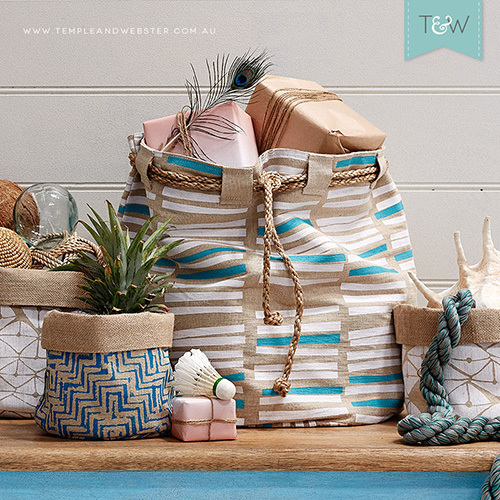
A collaboration between Shannon Sheedy of The Dharma Door and fabric designer Julie Paterson of Cloth Fabric seems like it was always meant to be. Both passionate about the power of community, they share a love for natural fibres and fabrics, and focus on hand-made work inspired by nature. Karen McCartney caught up with both Julie and Shannon to find out more.
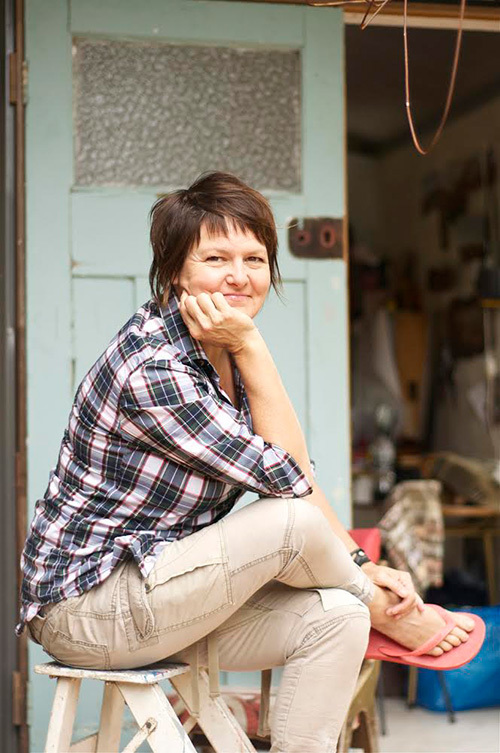
Julie, what drew the two of you together to create a collaborative range?
I met Shannon at a trade fair a couple of years ago. We had adjoining booths. I loved her paper products, her storage bags and her personality. All three things were natural fresh and lovely. She and her products and her ethics all seemed to go together well. Authentic, trustworthy, real. I am drawn to people like this - I enjoy developing a working relationship with people like Shannon and Mick.
I've always wanted to develop a fair trade product but didn't want to do it on my own. I produce all my own textiles locally. For 20 years I've been working with small-scale manufacturers here in NSW so I have not developed contacts with producers overseas. Over the years I've understood the benefits of partnering with people who share your passion but have different skills and experience. True teamwork that has good potential for longevity works best for everyone. I believe if you focus on the things you love, are good at them, and work with others who do the same, things fall into place. And they did. The 'Dharmas' have been great to work with. Their focus over the last 10 years has been to source and work with artisans who produce high quality products in small batches from impoverished communities in Bangladesh. Shannon travels at least twice a year to be amongst the makers and has seen the communities flourish; in particular she has been around long enough to see the younger girls staying at school finishing their education, marrying later, delaying having children, having more power in their lives. The Dharmas have built up a trust and a great working relationship with their makers and it showed in the products. So for me, getting involved with Shannon from a design perspective is working at my best. Along with every one else working at their best, together we produce the results we want easily.
Traditionally your inspiration is the Australian bush and landscape – did you deviate from that inspiration for this range?
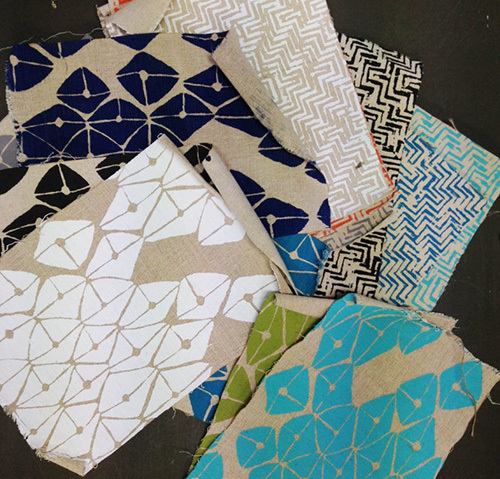
This first range is a 'best of Cloth' - a group of our best loved geometric designs, chosen because they work well on The Dharma Door products. The designs describe the Australian landscape in the form of symbols and motifs that themselves were drawings taken from my sketchbooks. Each design has a story attached to it too. Boardwalk ( the striped one) is about the erosion of the coast line - specifically the sand dunes and how we should always be mindful to walk on the boardwalks when we are at the beach. Spotcheck ( the spotty one) is about how we build connections when building new communities. The design was developed from a drawing I did when travelling down the south coast of NSW and seeing a bulldozer ploughing shapes and patterns into a hillside that used to have dairy cows on it. New homes were being made there instead. A bit of a shock initially but people need places to live and so this was pattern of progress. Wollemi ( the diamond shaped one) is a close up of the cone of a Wollemi pine, the most ancient living tree in the world ( which just so happens to live in my ' hood up in the Blue Mountains). So each design has its own story and each story is rooted into the Australian landscape in one way or another.
What colour palette have you chosen to work with and why?
The colours in this range are quite a bit brighter and cleaner than the colours I usually use. I'm probably best known for an earthy palette that feels like it's been dug up from the ground - oxide, bone and sepia - but this time I wanted to create a range of colours that were simple, fresh and clean. The Dharma Door products are accent pieces used in the home for flashes of colour to brighten up a corner of a room as well as practical storage solutions. So I went with a bright white, turquoise and indigo - high key, high contrast colours combined with the natural jute basecloth. And I'm loving this new direction, having already embraced it in my new designs for upholstery and curtaining fabric that come out very soon.
Natural fibres and non-toxic inks have always been core to the Cloth brand but was there any stretch in working with a company that is 100% fair trade?
When Shannon and I were first discussing the possibilities of working together I found out that the artists she works with all have the same kind of set up as I do in my shed up in the mountains. We are all very low-tech and hands on, old school style. We all screen print by hand with natural fabrics and water based inks yet we all work with the same basic technology too - a bit of Illustrator and Photoshop knowledge. Nothing too fancy, just the basics. So it was very straightforward working together as our processes all talked to each other.
How did the design process work?
Shannon gave me a range of the baskets to work with and I began translating my designs onto them, thinking about scale and the combinations of the designs that would work best.
I like to work with more design options than I need so that once sampled up we can pull out the final selection from a bigger initial group. I initially sent about 6 or 7 designs over to the artisans in Bangladesh, timing the artwork arriving by email with the arrival of Shannon to their workshop. She visits them regularly so together they have developed a great working relationship. Their communication is very good. A couple of designs were sampled whilst Shannon was there and when she returned she sent the swatches to me. With a little bit of back and forth tweaking colour or sometimes scale this was how the full range was completed - a couple at a time over a period of maybe 4 or 5 months. This back and forth and longer lead time for the development was the main difference for me from my usual experience of working locally with very quick turnaround times - but it wasn't too bad considering exactly where the work was coming from and how basic the facilities there.
I think Shannon went over twice during the sampling stage - she is a very hands on coordinator who takes a lot of trouble to make sure the products are as she wants them to be. I appreciate that effort she takes.
Did you visit the makers, or take their natural capabilities into consideration in the production of the range?
This time round I wasn't able to travel over to meet the makers and I relied entirely on Shannon's guidance and experience. The timing was tricky because whilst I was designing this range I've also been writing a book. And as any new author knows a book takes up every available spare moment.
This past year I've pretty well been chained to my desk and there was no possible way of travelling whilst I had an unedited manuscript staring at me day in day out. However, I do plan to travel to Bangladesh for the next range. Actually seeing where the work is being made always stimulates me into thinking outside the square. Talking directly to the artisans I know will bring unexpected opportunities and I'm looking forward to doing just that.
Will any of the items make their way to your Blue Mountains house?
Of course! In fact, many of the sample pieces are already there in use every day. I'm a notoriously untidy person with many projects on the go at any one time. The projects I've currently got stored in the baskets range from clean washing needing to be put away to new fabric swatches for my next fabric range. And rather than hiding all these piles of messy bundles I can proudly display them all over the house. A perfect collaboration result. Thank you Dharma Door xx

Shannon, as well as being Fair Trade it has always been important to you that the items are aesthetically pleasing. Is this a hard balance to achieve?
In a word…yes! The Dharma Door's aim is to bring the highest quality Fair Trade homewares and lifestyle products to a market that values contemporary design, while making a positive impact through trade. We are successfully bridging a large gap in the consumer market by observing trends and designing products that best utilise the artisans' skills, available natural raw materials and through consistent quality training. The biggest challenges when operating a Fair Trade business within a mainstream wholesale/retail model occur with production timeframes and quality issues. We have worked continuously over the past decade to address these challenges by developing effective strategies that respect the artisans, their community, family priorities, cultural differences, the impact of climate and lack of infrastructure.
What does it mean to be a Fair Trade company?
The Dharma Door practices the Ten Standards of Fair Trade, which means we are committed to providing product development, skills training, market opportunities, fair payment, women's empowerment and much more through our long-term trading partnerships with small-scale artisans in Bangladesh. We are also passionate about the positive flow-on effects for artisans such as their personal dignity, improved health and living conditions, education and a reduction in child marriage. We are proud to be actively promoting Fair Trade and sustainable ethics to a growing audience seeking style with substance.
You have always been aware that the consumer demand for your product is fundamental to keeping the artisans you work with employed. Does the collaboration with Cloth support this?
Absolutely! There is a direct correlation between consumer demand and our ability to contribute positive social and economic impacts within the artisans' communities. Cloth designs are bold, contemporary and have a loyal following. They are also inspired by nature and the Australian landscape so they sit beautifully against natural fibres, which is what our artisans work with. After many years of working together, our artisan partners understand the link between producing our product designs to the highest quality and the amount that we order from them. Collaborating with Julie on her designs will enable broader consumer appeal and ultimately the artisans will benefit. Cloth has now become an integral part of this very special Fair Trade story.
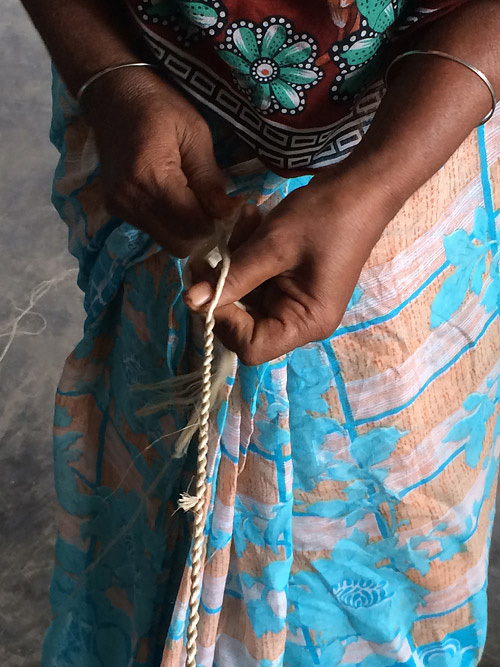
It takes about an hour to complete the rope for each Hessian Sack.
What was the process for the partnership with Cloth?
Julie and I met at a trade show a couple of years ago and she loved our jute wrapping paper and Fair Trade production practices. I had admired her work for a long time, especially the earthiness of the natural textiles and colours that she chooses. Our conversations around collaboration evolved this year and we felt that her designs would work really well on some of our other products including our Hessian Sacks and Duo's. Julie is authentic, open-minded and flexible, which has helped enormously during the development phase. Things always take longer in Bangladesh and she has been very patient considering the process has been quite different to her usual way of working. We met with Julie in Sydney and selected some designs and colours together. The sampling process with the artisans was lengthy as it was essential to interpret the designs well, not only for aesthetic reasons but also so can we be sure that we are honouring Julie's designs.
Has it driven any change to the product?
Fundamentally the product design of Hessian Sacks and Duo's has remained the same. We replaced the tassels with knots on the sacks, which was a great idea of Julie's.
Did the artisans you work with respond well to the designs?
The artisans are always excited to work with new designs as it keeps their work interesting and stimulating. During the sampling process, which I did face-to-face with them in May, they told me that they liked the boldness of Julie's designs. All of the screens are handmade and the inks are mixed by hand so there was a lot of detailed discussion over the colours and design sizes. This all helps to develop the artisans' skills and eye for detail and quality.
Julie is no stranger to jute and hessian – did she respond well to the materials?
Julie has a preference for natural fibres as we do, so that has made our partnership easy. The materials we work with are a little coarser than Julie usually works with however her bold designs have worked well on our jute/cotton blend. Julie's flexibility came into play here and she understood the limitations that our artisans currently face with regards to access to materials.
Do you think you will partner again? Has it driven any future plans?
We would love to continue to collaborate with Julie. We relate to one another on a very grounded and open level, so collaborating has been a truly enjoyable process. We have some ideas that would be new for both The Dharma Door and Cloth, which we're quite excited about. Stay tuned!
Shared passion: Cloth and The Dharma Door
A collaboration between Shannon Sheedy of The Dharma Door and fabric designer Julie Paterson of Cloth Fabric seems like it was always meant to be. Both passionate about the power of community, they share a love for natural fibres and fabrics, and focus on hand-made work inspired by nature. Karen McCartney caught up with both Julie and Shannon to find out more.
Julie, what drew the two of you together to create a collaborative range?
I met Shannon at a trade fair a couple of years ago. We had adjoining booths. I loved her paper products, her storage bags and her personality. All three things were natural fresh and lovely. She and her products and her ethics all seemed to go together well. Authentic, trustworthy, real. I am drawn to people like this - I enjoy developing a working relationship with people like Shannon and Mick.
I've always wanted to develop a fair trade product but didn't want to do it on my own. I produce all my own textiles locally. For 20 years I've been working with small-scale manufacturers here in NSW so I have not developed contacts with producers overseas. Over the years I've understood the benefits of partnering with people who share your passion but have different skills and experience. True teamwork that has good potential for longevity works best for everyone. I believe if you focus on the things you love, are good at them, and work with others who do the same, things fall into place. And they did. The 'Dharmas' have been great to work with. Their focus over the last 10 years has been to source and work with artisans who produce high quality products in small batches from impoverished communities in Bangladesh. Shannon travels at least twice a year to be amongst the makers and has seen the communities flourish; in particular she has been around long enough to see the younger girls staying at school finishing their education, marrying later, delaying having children, having more power in their lives. The Dharmas have built up a trust and a great working relationship with their makers and it showed in the products. So for me, getting involved with Shannon from a design perspective is working at my best. Along with every one else working at their best, together we produce the results we want easily.
Traditionally your inspiration is the Australian bush and landscape – did you deviate from that inspiration for this range?
This first range is a 'best of Cloth' - a group of our best loved geometric designs, chosen because they work well on The Dharma Door products. The designs describe the Australian landscape in the form of symbols and motifs that themselves were drawings taken from my sketchbooks. Each design has a story attached to it too. Boardwalk ( the striped one) is about the erosion of the coast line - specifically the sand dunes and how we should always be mindful to walk on the boardwalks when we are at the beach. Spotcheck ( the spotty one) is about how we build connections when building new communities. The design was developed from a drawing I did when travelling down the south coast of NSW and seeing a bulldozer ploughing shapes and patterns into a hillside that used to have dairy cows on it. New homes were being made there instead. A bit of a shock initially but people need places to live and so this was pattern of progress. Wollemi ( the diamond shaped one) is a close up of the cone of a Wollemi pine, the most ancient living tree in the world ( which just so happens to live in my ' hood up in the Blue Mountains). So each design has its own story and each story is rooted into the Australian landscape in one way or another.
What colour palette have you chosen to work with and why?
The colours in this range are quite a bit brighter and cleaner than the colours I usually use. I'm probably best known for an earthy palette that feels like it's been dug up from the ground - oxide, bone and sepia - but this time I wanted to create a range of colours that were simple, fresh and clean. The Dharma Door products are accent pieces used in the home for flashes of colour to brighten up a corner of a room as well as practical storage solutions. So I went with a bright white, turquoise and indigo - high key, high contrast colours combined with the natural jute basecloth. And I'm loving this new direction, having already embraced it in my new designs for upholstery and curtaining fabric that come out very soon.
Natural fibres and non-toxic inks have always been core to the Cloth brand but was there any stretch in working with a company that is 100% fair trade?
When Shannon and I were first discussing the possibilities of working together I found out that the artists she works with all have the same kind of set up as I do in my shed up in the mountains. We are all very low-tech and hands on, old school style. We all screen print by hand with natural fabrics and water based inks yet we all work with the same basic technology too - a bit of Illustrator and Photoshop knowledge. Nothing too fancy, just the basics. So it was very straightforward working together as our processes all talked to each other.
How did the design process work?
Shannon gave me a range of the baskets to work with and I began translating my designs onto them, thinking about scale and the combinations of the designs that would work best.
I like to work with more design options than I need so that once sampled up we can pull out the final selection from a bigger initial group. I initially sent about 6 or 7 designs over to the artisans in Bangladesh, timing the artwork arriving by email with the arrival of Shannon to their workshop. She visits them regularly so together they have developed a great working relationship. Their communication is very good. A couple of designs were sampled whilst Shannon was there and when she returned she sent the swatches to me. With a little bit of back and forth tweaking colour or sometimes scale this was how the full range was completed - a couple at a time over a period of maybe 4 or 5 months. This back and forth and longer lead time for the development was the main difference for me from my usual experience of working locally with very quick turnaround times - but it wasn't too bad considering exactly where the work was coming from and how basic the facilities there.
I think Shannon went over twice during the sampling stage - she is a very hands on coordinator who takes a lot of trouble to make sure the products are as she wants them to be. I appreciate that effort she takes.
Did you visit the makers, or take their natural capabilities into consideration in the production of the range?
This time round I wasn't able to travel over to meet the makers and I relied entirely on Shannon's guidance and experience. The timing was tricky because whilst I was designing this range I've also been writing a book. And as any new author knows a book takes up every available spare moment.
This past year I've pretty well been chained to my desk and there was no possible way of travelling whilst I had an unedited manuscript staring at me day in day out. However, I do plan to travel to Bangladesh for the next range. Actually seeing where the work is being made always stimulates me into thinking outside the square. Talking directly to the artisans I know will bring unexpected opportunities and I'm looking forward to doing just that.
Will any of the items make their way to your Blue Mountains house?
Of course! In fact, many of the sample pieces are already there in use every day. I'm a notoriously untidy person with many projects on the go at any one time. The projects I've currently got stored in the baskets range from clean washing needing to be put away to new fabric swatches for my next fabric range. And rather than hiding all these piles of messy bundles I can proudly display them all over the house. A perfect collaboration result. Thank you Dharma Door xx
Shannon, as well as being Fair Trade it has always been important to you that the items are aesthetically pleasing. Is this a hard balance to achieve?
In a word…yes! The Dharma Door's aim is to bring the highest quality Fair Trade homewares and lifestyle products to a market that values contemporary design, while making a positive impact through trade. We are successfully bridging a large gap in the consumer market by observing trends and designing products that best utilise the artisans' skills, available natural raw materials and through consistent quality training. The biggest challenges when operating a Fair Trade business within a mainstream wholesale/retail model occur with production timeframes and quality issues. We have worked continuously over the past decade to address these challenges by developing effective strategies that respect the artisans, their community, family priorities, cultural differences, the impact of climate and lack of infrastructure.
What does it mean to be a Fair Trade company?
The Dharma Door practices the Ten Standards of Fair Trade, which means we are committed to providing product development, skills training, market opportunities, fair payment, women's empowerment and much more through our long-term trading partnerships with small-scale artisans in Bangladesh. We are also passionate about the positive flow-on effects for artisans such as their personal dignity, improved health and living conditions, education and a reduction in child marriage. We are proud to be actively promoting Fair Trade and sustainable ethics to a growing audience seeking style with substance.
You have always been aware that the consumer demand for your product is fundamental to keeping the artisans you work with employed. Does the collaboration with Cloth support this?
Absolutely! There is a direct correlation between consumer demand and our ability to contribute positive social and economic impacts within the artisans' communities. Cloth designs are bold, contemporary and have a loyal following. They are also inspired by nature and the Australian landscape so they sit beautifully against natural fibres, which is what our artisans work with. After many years of working together, our artisan partners understand the link between producing our product designs to the highest quality and the amount that we order from them. Collaborating with Julie on her designs will enable broader consumer appeal and ultimately the artisans will benefit. Cloth has now become an integral part of this very special Fair Trade story.
It takes about an hour to complete the rope for each Hessian Sack.
What was the process for the partnership with Cloth?
Julie and I met at a trade show a couple of years ago and she loved our jute wrapping paper and Fair Trade production practices. I had admired her work for a long time, especially the earthiness of the natural textiles and colours that she chooses. Our conversations around collaboration evolved this year and we felt that her designs would work really well on some of our other products including our Hessian Sacks and Duo's. Julie is authentic, open-minded and flexible, which has helped enormously during the development phase. Things always take longer in Bangladesh and she has been very patient considering the process has been quite different to her usual way of working. We met with Julie in Sydney and selected some designs and colours together. The sampling process with the artisans was lengthy as it was essential to interpret the designs well, not only for aesthetic reasons but also so can we be sure that we are honouring Julie's designs.
Has it driven any change to the product?
Fundamentally the product design of Hessian Sacks and Duo's has remained the same. We replaced the tassels with knots on the sacks, which was a great idea of Julie's.
Did the artisans you work with respond well to the designs?
The artisans are always excited to work with new designs as it keeps their work interesting and stimulating. During the sampling process, which I did face-to-face with them in May, they told me that they liked the boldness of Julie's designs. All of the screens are handmade and the inks are mixed by hand so there was a lot of detailed discussion over the colours and design sizes. This all helps to develop the artisans' skills and eye for detail and quality.
Julie is no stranger to jute and hessian – did she respond well to the materials?
Julie has a preference for natural fibres as we do, so that has made our partnership easy. The materials we work with are a little coarser than Julie usually works with however her bold designs have worked well on our jute/cotton blend. Julie's flexibility came into play here and she understood the limitations that our artisans currently face with regards to access to materials.
Do you think you will partner again? Has it driven any future plans?
We would love to continue to collaborate with Julie. We relate to one another on a very grounded and open level, so collaborating has been a truly enjoyable process. We have some ideas that would be new for both The Dharma Door and Cloth, which we're quite excited about. Stay tuned!
Explore More








Head Office (No Showroom)
2/1-7 Unwins Bridge Rd, St Peters,
NSW 2044, Australia
Your customer reference #:
01-X-CSN