



Updated 28 May 2021
Know your classics: Danish design
We are thrilled to have collaborated with Great Dane Furniture featuring vintage Danish design pieces. Danish design is revered for its simplicity, organic shapes and fusion of form and function. Design expert Monique Rappell is back to give us her perspective on what makes Scandinavian design so special.
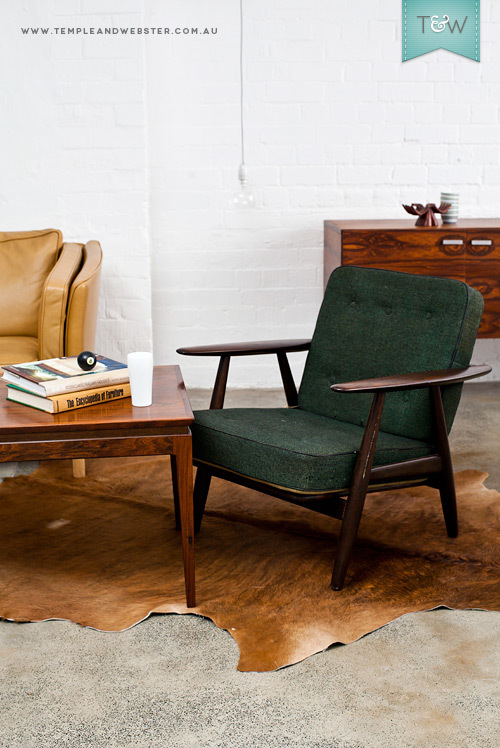
One of the curious things about Danish design is that we call it "Danish design". We don't look at an Eames chair and say, "American Design" - it's an Eames chair. We don't look at a Le Corbusier chair and comment on the quality of Swiss design - it's a Le Corbusier. Why then are the likes of Arne Jacobsen, Finn Juhl, Kaare Klint, and Hans J Wegner - some of the best designers of the 20th century - more often than not discussed under the banner of Danish design?
The reason may stem from an essential quality of design from Denmark between the 1920s and the 1960s. This period was not defined by hero designers, but by a collective design philosophy adopted, adapted and refined by each designer. Often called Danish functionalism (or organic functionalism), this philosophy was derived from essential Danish conditions – a belief in the equality of quality and beauty, long winters indoors, a close relationship to nature, and a sense of frugality and ingenuity with materials. While Danish furniture was never designed to say "look at me!", it embeds understated references to nature, creating a unique type of clean but sensual form.
While there are ubiquitous pieces of Danish design such as Hans Wagner's Wishbone chair, Arne Jacobsen's Swan chair, and Poul Henningsen's Artichoke Pedant Light, we normally think of a particular look, not a designer. Danish timber furniture in particular is visually lean, but not harsh. A term I recently learnt from watching Eat Pray Love (don't judge me) describes it beautifully – "false thin". Thin from a distance, but curvy and sensual up close. Legs taper, arms curve, edges sweep and handles just feel right. Upholstery is simple but elegant, tactile but without ornament.
There is a reason Danish design endures - it was designed to outlive its owners. Or more simply put, it was designed with resilience. Resilience is a quality found in happy people who live long healthy lives. They are flexible, adaptable and have a strong internal balance. They have a keen sense of purpose, but take their pleasure seriously. So too does Danish furniture. It makes us happy. It's elegant, refined and has a simple beauty more like a daisy than a rose. It salves us emotionally and physically. It appeals to our brains, our fingertips and our hearts. Perhaps the reason we don't name Danish designers is because we don't need to. After all, what is a name other than a fancy ornament? Would a Danish chair under any other name, feel as sweet? Ja, I think we know all the answer to that.
One of the curious things about Danish design is that we call it "Danish design". We don't look at an Eames chair and say, "American Design" - it's an Eames chair. We don't look at a Le Corbusier chair and comment on the quality of Swiss design - it's a Le Corbusier. Why then are the likes of Arne Jacobsen, Finn Juhl, Kaare Klint, and Hans J Wegner - some of the best designers of the 20th century - more often than not discussed under the banner of Danish design?
The reason may stem from an essential quality of design from Denmark between the 1920s and the 1960s. This period was not defined by hero designers, but by a collective design philosophy adopted, adapted and refined by each designer. Often called Danish functionalism (or organic functionalism), this philosophy was derived from essential Danish conditions – a belief in the equality of quality and beauty, long winters indoors, a close relationship to nature, and a sense of frugality and ingenuity with materials. While Danish furniture was never designed to say "look at me!", it embeds understated references to nature, creating a unique type of clean but sensual form.
While there are ubiquitous pieces of Danish design such as Hans Wagner's Wishbone chair, Arne Jacobsen's Swan chair, and Poul Henningsen's Artichoke Pedant Light, we normally think of a particular look, not a designer. Danish timber furniture in particular is visually lean, but not harsh. A term I recently learnt from watching Eat Pray Love (don't judge me) describes it beautifully – "false thin". Thin from a distance, but curvy and sensual up close. Legs taper, arms curve, edges sweep and handles just feel right. Upholstery is simple but elegant, tactile but without ornament.
There is a reason Danish design endures - it was designed to outlive its owners. Or more simply put, it was designed with resilience. Resilience is a quality found in happy people who live long healthy lives. They are flexible, adaptable and have a strong internal balance. They have a keen sense of purpose, but take their pleasure seriously. So too does Danish furniture. It makes us happy. It's elegant, refined and has a simple beauty more like a daisy than a rose. It salves us emotionally and physically. It appeals to our brains, our fingertips and our hearts. Perhaps the reason we don't name Danish designers is because we don't need to. After all, what is a name other than a fancy ornament? Would a Danish chair under any other name, feel as sweet? Ja, I think we know all the answer to that.
Explore More








Head Office (No Showroom)
2/1-7 Unwins Bridge Rd, St Peters,
NSW 2044, Australia
Your customer reference #:
01-X-CSN