


Blog

Updated 10 February 2021
We asked Cate Burton, the creator of Queen B natural beeswax candles, to tell us more about the magic of the material she loves.
How did you discover beeswax and what do you love about it?
I discovered beeswax when I took up candlemaking as a hobby. I'm a bit of a researcher (which has held me in good stead with Queen B) and in looking into the different types of candles, I found that beeswax candles were non toxic to burn, unlike some other types. Being asthmatic, I wanted to make a product that didn't contribute to air pollution.
There are so many things I love about beeswax, from its provenance to its qualities. A worker bee makes around 1/8th of a pinkie nail of beeswax in her lifetime – meaning there is a life's work of around 1,000 female worker bees in every tealight candle. That's why I treat the wax with such reverence.
I think it is a privilege to make natural, bee created light for a living. Whether we're lighting a meditation, bed time story, bath, a dinner party or a wedding, it is an extraordinary thing to light up that occasion. I personally think that candles create 100% of the ambience of any occasion so I'm always a little surprised when people spend $20,000 on a wedding and then use cheap tealights! I LOVE being an Australian manufacturer. I LOVE that we never compromise and I LOVE that we make a difference every single day to Australian beekeepers, the regional communities they live in, all of the Australian artisans we support, and to the environment.
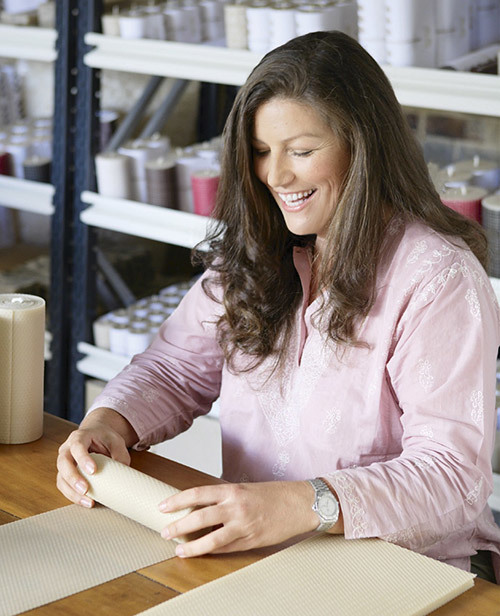
Cate rolling candles at her Sydney workshop.
Where do you source the wax and other materials? (Do you eat a lot of honey?!)
We source our beeswax only within Australia. Unfortunately because of the drought, honey and wax supplies have been down 30 – 50% over the past couple of years and we're competing for the wax on the global market because Australian beeswax is highly sought after by pharmaceutical and cosmetics companies as it is free from miticides (a chemical beekeepers use to control the varroa mite – Australia being the only country in the world that doesn't have the mite).
Yes, I eat a lot of honey. Until a few weeks ago I had 2 beehives on my apartment balcony in Neutral Bay. Eating honey that had been foraged from the trees and flowers surrounding where I live was a great privilege.
How are your candles made – what is the process?
Before making the candles we clean the beeswax thoroughly which takes over 72 hours to allow time for the impurities to settle out to ensure there's nothing in the wax to clog the wick and that the candles don't smoke. We have over 1,000 different pure cotton wicks at our disposal, so we wick test thoroughly to get the perfect wick for the candle we're testing for.
We choose to make every candle by hand, giving the wax the respect I believe it deserves. We have 3 main processes that we use. Our rolled pillar candles are all hand-rolled. Our Bee Lights, Thins and 45cm Tapers are dipped and everything else in the range is hand poured from an enamel teapot.
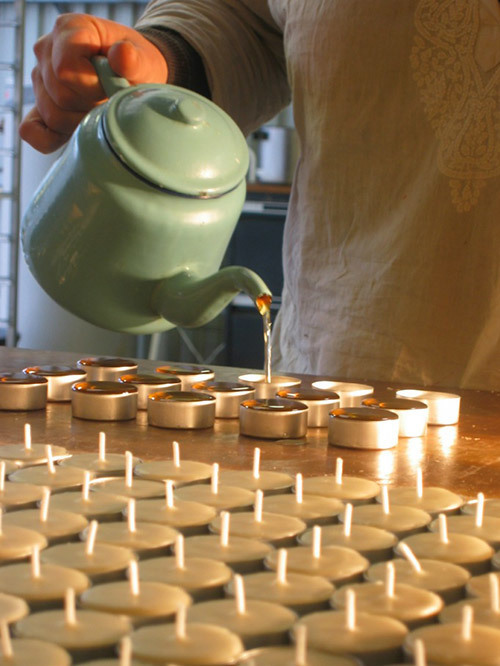
Tealight candles are poured using an enamel teapot.
Are your candles naturally scented?
Beeswax candles have a natural, light honey aroma. We don't fragrance them as all essential oils come with a Material Safety Data Sheet (MSDS) which advises that carcinogens are released if the oil is combusted, which is what happens when you add oil to a candle and light the flame. Sometimes when you fiddle too much with nature you can turn something that was safe and non-toxic into something that's less safe, simply by using it in a way in which nature didn't intend.
What colour is beeswax?
Beeswax is white when it is made by bees. Any colour in beeswax is the result of staining (by honey and pollen) and impurities (honey, pollen and propollis). Each of these impurities can affect how a beeswax candle burns, so we source honey from very experienced (3rd or 4th generation) beekeepers who know to treat the wax like gold in the first place and then we take 72 hours to remove more impurities with water, time and filtration. It's a proprietary method that we've developed over 10 years and it is one of the two things that makes a Queen B candle burn beautifully every time… the other is our fanaticism over wick testing and finding the 'right' wick.
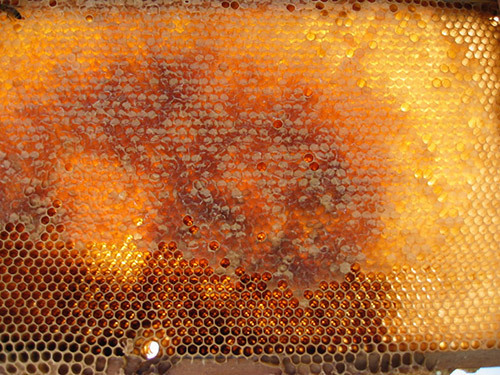
A frame of honey - an excellent byproduct of the process.
When should you choose to use a taper candle over a pillar?
Tapers are the best value candles in our range in terms of price per hour to burn, but should only ever be burned where there is no breeze (be that an actual breeze or a fan or air conditioning). Any taper will drip in a breeze, which is a waste of wax and burn time. Pillar candles have more 'impact' as a statement piece and are great for longer burn times – like when you're entertaining.
Putting any candle behind glass (for example in a hurricane lantern, jar or vase) is great because the light reflects off the glass giving you 3 – 4 times the light out of every candle.
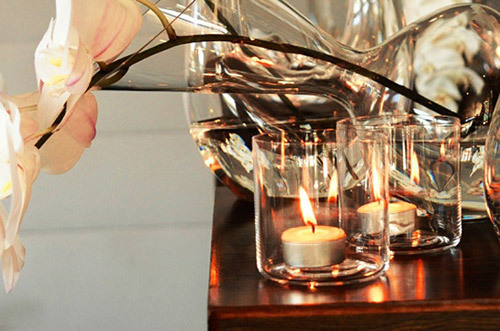
Putting tealights in a glass container increases the amount of light they give off.
What do you think beeswax candles add to a space?
For me, lighting candles is a ritual and adds calmness and serenity to a space. Beeswax candles are said to be a natural ioniser when they're burning which means that they also purify the air in your home.
We have many customers that use them to calm children down in the evening before dinner and many customers who use them as a stress management tool!
We've all heard about circadian rhythms which are basically the human body's awake and sleep patterns. Historically, people tended to finish work at sun down and then have several hours before bed (without artificial light and TV's and devices) to calm their minds down and for melatonin to kick in. Now we're stimulated until we go to bed and we have a generation of people with sleep problems. The first thing I do when I get home is light 3 candles and turn on 2 lamps. The lighting is calm and muted (and my electricity bills average around $200 per quarter)!
How many candles do you have in your own home?
I tend to light 3 candles most evenings and more if I am entertaining. I worked out last year that it is cheaper to light 3 of our taper candles 4-5 nights a week (and switch off 3 lights) than it is to have the lights lit!
How to make the most of beeswax candles
 Photograph - Natalie Hunfalvay. Styling - Adam Powell.
We asked Cate Burton, the creator of Queen B natural beeswax candles, to tell us more about the magic of the material she loves.
How did you discover beeswax and what do you love about it?
I discovered beeswax when I took up candlemaking as a hobby. I'm a bit of a researcher (which has held me in good stead with Queen B) and in looking into the different types of candles, I found that beeswax candles were non toxic to burn, unlike some other types. Being asthmatic, I wanted to make a product that didn't contribute to air pollution.
There are so many things I love about beeswax, from its provenance to its qualities. A worker bee makes around 1/8th of a pinkie nail of beeswax in her lifetime – meaning there is a life's work of around 1,000 female worker bees in every tealight candle. That's why I treat the wax with such reverence.
I think it is a privilege to make natural, bee created light for a living. Whether we're lighting a meditation, bed time story, bath, a dinner party or a wedding, it is an extraordinary thing to light up that occasion. I personally think that candles create 100% of the ambience of any occasion so I'm always a little surprised when people spend $20,000 on a wedding and then use cheap tealights! I LOVE being an Australian manufacturer. I LOVE that we never compromise and I LOVE that we make a difference every single day to Australian beekeepers, the regional communities they live in, all of the Australian artisans we support, and to the environment.
Cate rolling candles at her Sydney workshop.
Where do you source the wax and other materials? (Do you eat a lot of honey?!)
We source our beeswax only within Australia. Unfortunately because of the drought, honey and wax supplies have been down 30 – 50% over the past couple of years and we're competing for the wax on the global market because Australian beeswax is highly sought after by pharmaceutical and cosmetics companies as it is free from miticides (a chemical beekeepers use to control the varroa mite – Australia being the only country in the world that doesn't have the mite).
Yes, I eat a lot of honey. Until a few weeks ago I had 2 beehives on my apartment balcony in Neutral Bay. Eating honey that had been foraged from the trees and flowers surrounding where I live was a great privilege.
How are your candles made – what is the process?
Before making the candles we clean the beeswax thoroughly which takes over 72 hours to allow time for the impurities to settle out to ensure there's nothing in the wax to clog the wick and that the candles don't smoke. We have over 1,000 different pure cotton wicks at our disposal, so we wick test thoroughly to get the perfect wick for the candle we're testing for.
We choose to make every candle by hand, giving the wax the respect I believe it deserves. We have 3 main processes that we use. Our rolled pillar candles are all hand-rolled. Our Bee Lights, Thins and 45cm Tapers are dipped and everything else in the range is hand poured from an enamel teapot.
Tealight candles are poured using an enamel teapot.
Are your candles naturally scented?
Beeswax candles have a natural, light honey aroma. We don't fragrance them as all essential oils come with a Material Safety Data Sheet (MSDS) which advises that carcinogens are released if the oil is combusted, which is what happens when you add oil to a candle and light the flame. Sometimes when you fiddle too much with nature you can turn something that was safe and non-toxic into something that's less safe, simply by using it in a way in which nature didn't intend.
What colour is beeswax?
Beeswax is white when it is made by bees. Any colour in beeswax is the result of staining (by honey and pollen) and impurities (honey, pollen and propollis). Each of these impurities can affect how a beeswax candle burns, so we source honey from very experienced (3rd or 4th generation) beekeepers who know to treat the wax like gold in the first place and then we take 72 hours to remove more impurities with water, time and filtration. It's a proprietary method that we've developed over 10 years and it is one of the two things that makes a Queen B candle burn beautifully every time… the other is our fanaticism over wick testing and finding the 'right' wick.
A frame of honey - an excellent byproduct of the process.
When should you choose to use a taper candle over a pillar?
Tapers are the best value candles in our range in terms of price per hour to burn, but should only ever be burned where there is no breeze (be that an actual breeze or a fan or air conditioning). Any taper will drip in a breeze, which is a waste of wax and burn time. Pillar candles have more 'impact' as a statement piece and are great for longer burn times – like when you're entertaining.
Putting any candle behind glass (for example in a hurricane lantern, jar or vase) is great because the light reflects off the glass giving you 3 – 4 times the light out of every candle.
Putting tealights in a glass container increases the amount of light they give off.
What do you think beeswax candles add to a space?
For me, lighting candles is a ritual and adds calmness and serenity to a space. Beeswax candles are said to be a natural ioniser when they're burning which means that they also purify the air in your home.
We have many customers that use them to calm children down in the evening before dinner and many customers who use them as a stress management tool!
We've all heard about circadian rhythms which are basically the human body's awake and sleep patterns. Historically, people tended to finish work at sun down and then have several hours before bed (without artificial light and TV's and devices) to calm their minds down and for melatonin to kick in. Now we're stimulated until we go to bed and we have a generation of people with sleep problems. The first thing I do when I get home is light 3 candles and turn on 2 lamps. The lighting is calm and muted (and my electricity bills average around $200 per quarter)!
How many candles do you have in your own home?
I tend to light 3 candles most evenings and more if I am entertaining. I worked out last year that it is cheaper to light 3 of our taper candles 4-5 nights a week (and switch off 3 lights) than it is to have the lights lit!
Explore More



Payment options





Head Office (No Showroom)
2/1-7 Unwins Bridge Rd, St Peters,
NSW 2044, Australia
Your customer reference #:
01-X-CSN