



Updated 16 February 2021
Sandcastles: Interiors inspired by the coast
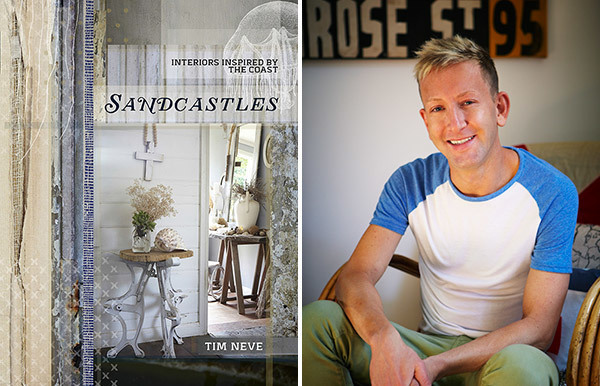
Stylist Tim Neve says interiors are in his blood. He grew up by the beach in Newcastle, where earlier generations of Neves had owned furniture stores and workshops, and he was the driving force behind Australian Coastal Home magazine. His new book, Sandcastles, published by Murdoch Books, reflects his enduring connection to the sea as it explores several different facets of coastal style. Here Tim shares an introduction to the idea behind his book, and a few styling tips to help you create your own coastal interior. Leave a comment for your chance to win a copy – full details below.
Foundations of style
Building sandcastles is a wonderful activity: no two castles are ever the same; each pile of sand is crafted uniquely and takes on an aesthetic that, perhaps, reflects the sculptor's personality. The most exciting part is the final decoration, a little like icing a cake but, in this case, the finishing touch might be a special shell or drape of seaweed to mark the design as one's own.
Such a metaphor seemed fitting on my journey to make this book, visiting homeowners who had created their own 'sandcastles'. Each home was close to, or inspired by, the shore and paid homage to the sea. What quickly emerged was how different they could be, from a revamped 1940s caravan on the water's edge in Frankston, Victoria, to a tepee structure in the laidback town of Bangalow, New South Wales. All lovingly created and cared for by their owners as their unique take on coastal style.
Finding inspiration in your surroundings
If there's one thing I'm adamant about, it's that for modern coastal styling to be truly authentic the inspiration has to come from the source. In contrast, by simply looking at editorial shots in magazines and imitating the décor, all we end up with is a diluted variation on the initial theme.
So, if you're lucky enough to be close by, take a walk along the ocean shoreline. What do you find that can be collected as inspiration? These lengths of sand are prime spots to discover free textural swatches for your home: the pearly oyster tones of a washed-up shell; the sea- and sun-battered patina of driftwood; the spiky organic forms of sea life; the corroded rock faces bubbling into new forms.
Inspiration can come from anywhere, and can be both natural and constructed: consider the primary-coloured nautical iconography at a marina or weathered signage of a lifeguard station. How could each of these be reinterpreted in your home? In thinking about this, you'll come up with a unique styling solution that resonates honestly and far more strongly than a decorative item straight off the shelf of a shop.
If you don't have a nearby shoreline to explore, pull out photos and postcards from your favourite coastal getaways. What fond memories do these conjure up for you? And, once again, how could you use those elements that stand out for you to create a vibe of natural escape in your home?
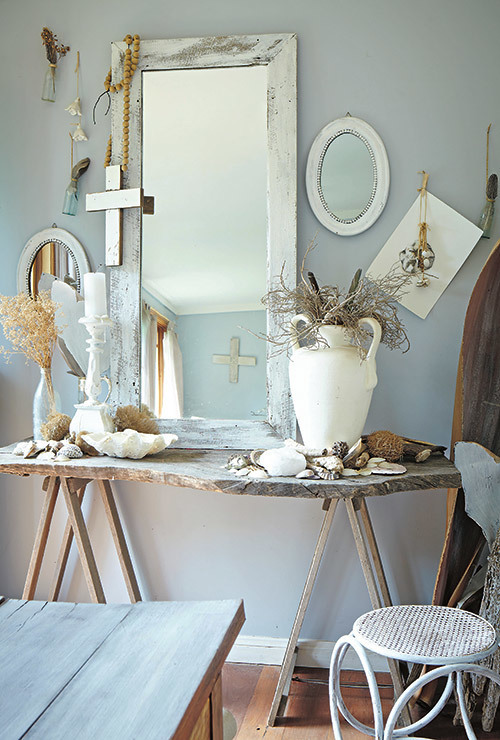
The beachcomber interior celebrates the natural sunbleached tones and sea-worn textures of salvaged treasures. Here, a free-form slab of reclaimed timber becomes a simple console table propped up on vintage trestle legs. Covered in found seaside objects, it's a pleasant greeting upon entering this home, and hints at the inspiration and aesthetic to be found further within. A group of whitewash-framed mirrors assembles on the muted grey well, while bits of driftwood and oversized palm bark strips lean lazily in the corner. This vignette particularly delights me as nothing within the collection seems permanently placed. The tactile nature of each object invites you to pick it up, examine it, and perhaps even rearrange it to your liking. When creating your own vignette, notice how you are analysing the scale, form and final placement of each item – it's a style laboratory waiting to be played with.
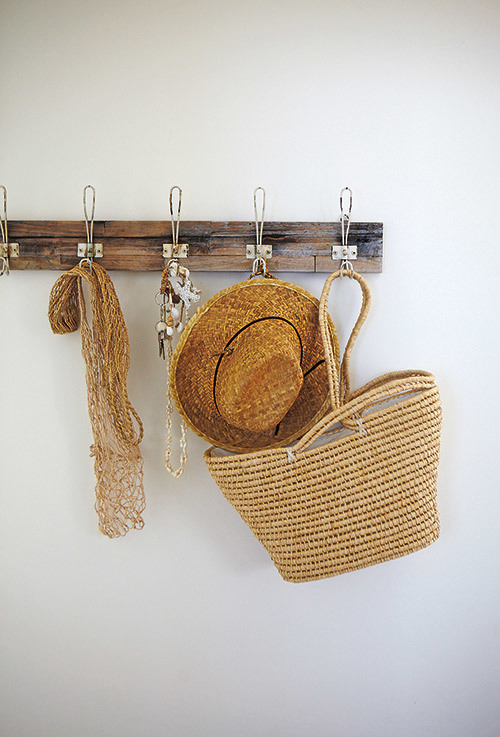
Styling tip: For design impact, group like items: a collection of rough-edged raffia sunhats perched on hooks becomes a striking and cost-effective design feature that captures memories of relaxed coastal walks, no matter how far your house is from the shore.
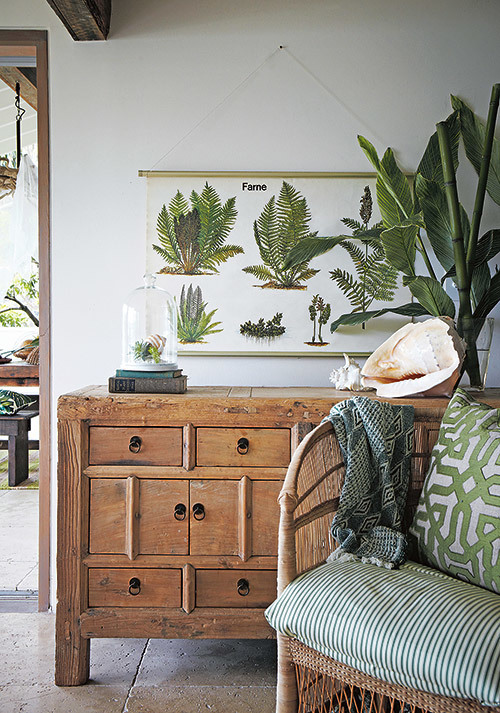
Islander style features a leafy, woody scheme inspired by the earthy abundance of a tropical island. Here, a vintage German teaching chart demonstrated a variety of ferns and sets the leafy tone, while the collection of seashells emphasises the coastal connection. On the chair, a classic ticking fabric in green (rather than the more usual blue or red) mixes with a lattice-print linen cushion and a tactile ikat throw with worn fringing. All the green tones here – from lime green to bottle green – create a pleasant spectrum, balanced by the gentle wood hues and the vintage-paper tone of the fern wall chart.
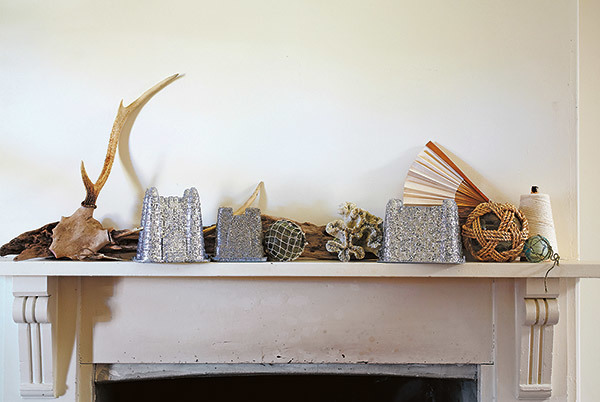
Glitter covered sandcastle moulds become the unique feature piece on this mantelpiece, complemented by other finds such as glass floats with decaying rope enclosures, a reel of twine, a length of twisted driftwood, a blank paper fan and even an antler that casts wonderful shadows across the composition. Executed in neutrals, it is a testament to the power of texture – as opposed to colour an pattern – to create mood.
DIY idea: Seek out plastic sandcastle buckets of all shapes and sizes from discount and toy shops. Paint the outside with a coat of PVA wood glue and, while still wet, pour glitter over the top, making sure it gets into all the sculpted cavities. It's a messy process, best done over a lot of old newspaper. I like to use glitter in larger shards or chunks, rather than the fine variety, to achieve the best result.
Foundations of style
Building sandcastles is a wonderful activity: no two castles are ever the same; each pile of sand is crafted uniquely and takes on an aesthetic that, perhaps, reflects the sculptor's personality. The most exciting part is the final decoration, a little like icing a cake but, in this case, the finishing touch might be a special shell or drape of seaweed to mark the design as one's own.
Such a metaphor seemed fitting on my journey to make this book, visiting homeowners who had created their own 'sandcastles'. Each home was close to, or inspired by, the shore and paid homage to the sea. What quickly emerged was how different they could be, from a revamped 1940s caravan on the water's edge in Frankston, Victoria, to a tepee structure in the laidback town of Bangalow, New South Wales. All lovingly created and cared for by their owners as their unique take on coastal style.
Finding inspiration in your surroundings
If there's one thing I'm adamant about, it's that for modern coastal styling to be truly authentic the inspiration has to come from the source. In contrast, by simply looking at editorial shots in magazines and imitating the décor, all we end up with is a diluted variation on the initial theme.
So, if you're lucky enough to be close by, take a walk along the ocean shoreline. What do you find that can be collected as inspiration? These lengths of sand are prime spots to discover free textural swatches for your home: the pearly oyster tones of a washed-up shell; the sea- and sun-battered patina of driftwood; the spiky organic forms of sea life; the corroded rock faces bubbling into new forms.
Inspiration can come from anywhere, and can be both natural and constructed: consider the primary-coloured nautical iconography at a marina or weathered signage of a lifeguard station. How could each of these be reinterpreted in your home? In thinking about this, you'll come up with a unique styling solution that resonates honestly and far more strongly than a decorative item straight off the shelf of a shop.
If you don't have a nearby shoreline to explore, pull out photos and postcards from your favourite coastal getaways. What fond memories do these conjure up for you? And, once again, how could you use those elements that stand out for you to create a vibe of natural escape in your home?
The beachcomber interior celebrates the natural sunbleached tones and sea-worn textures of salvaged treasures. Here, a free-form slab of reclaimed timber becomes a simple console table propped up on vintage trestle legs. Covered in found seaside objects, it's a pleasant greeting upon entering this home, and hints at the inspiration and aesthetic to be found further within. A group of whitewash-framed mirrors assembles on the muted grey well, while bits of driftwood and oversized palm bark strips lean lazily in the corner. This vignette particularly delights me as nothing within the collection seems permanently placed. The tactile nature of each object invites you to pick it up, examine it, and perhaps even rearrange it to your liking. When creating your own vignette, notice how you are analysing the scale, form and final placement of each item – it's a style laboratory waiting to be played with.
Styling tip: For design impact, group like items: a collection of rough-edged raffia sunhats perched on hooks becomes a striking and cost-effective design feature that captures memories of relaxed coastal walks, no matter how far your house is from the shore.
Islander style features a leafy, woody scheme inspired by the earthy abundance of a tropical island. Here, a vintage German teaching chart demonstrated a variety of ferns and sets the leafy tone, while the collection of seashells emphasises the coastal connection. On the chair, a classic ticking fabric in green (rather than the more usual blue or red) mixes with a lattice-print linen cushion and a tactile ikat throw with worn fringing. All the green tones here – from lime green to bottle green – create a pleasant spectrum, balanced by the gentle wood hues and the vintage-paper tone of the fern wall chart.
Glitter covered sandcastle moulds become the unique feature piece on this mantelpiece, complemented by other finds such as glass floats with decaying rope enclosures, a reel of twine, a length of twisted driftwood, a blank paper fan and even an antler that casts wonderful shadows across the composition. Executed in neutrals, it is a testament to the power of texture – as opposed to colour an pattern – to create mood.
DIY idea: Seek out plastic sandcastle buckets of all shapes and sizes from discount and toy shops. Paint the outside with a coat of PVA wood glue and, while still wet, pour glitter over the top, making sure it gets into all the sculpted cavities. It's a messy process, best done over a lot of old newspaper. I like to use glitter in larger shards or chunks, rather than the fine variety, to achieve the best result.
Explore More








Head Office (No Showroom)
2/1-7 Unwins Bridge Rd, St Peters,
NSW 2044, Australia
Your customer reference #:
01-X-CSN