



Updated 28 May 2021
Know your classics: Eames Lounge and Ottoman
Inspired by our first ever feature with Sydney's Living Edge, Monique Rappell from the Whitehouse Institute of Design explains in gushing prose just why she's so heart-poundingly enamoured with this modern classic. And why you will be too.
Sometimes love can sneak up on you. Without knowing why, you suddenly feel content. Your sense of self is clearly defined and rewarded. This new relationship paradoxically offers comfort and a sense of adventure. You feel embraced. Your sense of the sensual returns and your body awakens.
I know a man who once embarked on building himself a luxurious studio overlooking rolling hills and glistening sea. Within this unfinished space he housed his heart's one desire, and found such joy and satisfaction that he would not share the space with anyone or anything else for months. He confessed this love was an object that gave him such pleasure that he had completely lost the desire to finish the studio. This object of his affections was the Eames Lounge.
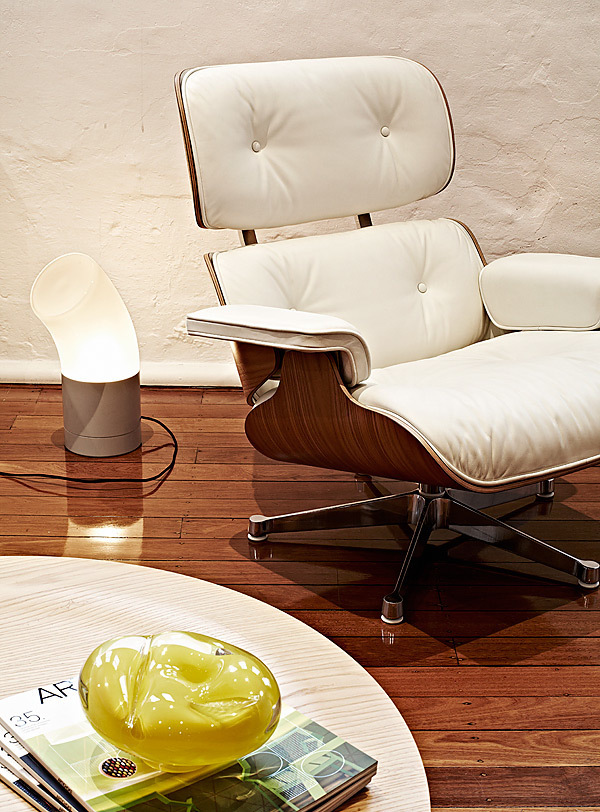
Commissioned in the 1950s by Michigan's Herman Miller Company, the husband and wife team of Charles and Ray Eames created a contrast to the modernist pieces of Europe that so often lacked warmth and comfort. The Eames Lounge holds you like a lover or a parent, depending on which you need most at the time. It is both sensual and deeply comforting.
It is said the Eames Lounge was inspired by the worn and softened leather of a baseball mitt. This is no minor cultural reference for Americans. It represents craft, heritage, loyalty, strength, skill and finesse, qualities this chair still possesses.
While most chairs are static, this is dynamic. It not only suggests the curve of the hand, but celebrates the way the body moves with its touch. While always supportive, the chair is permanently reclined, literally begging you to put your feet up, while the swivel base allows you to shift focus while chatting, dreaming or creating.
Like all pieces of high design, the magic lies in a tiny innovation. For the Eames, it is the use of rubber fixtures that sit between the metal supports and the plywood shells at the back of the chair. Given the now uncommonly high back, this is vital as it enables the back and neck rest to gently move with the body. Too much and you feel unsupported, too little and you feel tortured. As Goldilocks might utter in a satisfied tone, the Eames is "just right".
In almost continuous production since 1956, the Eames 670 Lounge and 671 Ottoman have earned their right to be called classics. They are as modern today as they were in their youth. If you fall for the Eames Lounge, which you almost certainly will, understand this is no ordinary object of desire. The Eames Lounge chair and ottoman is more than a passing crush. It is true love, and should be sold with a cautionary warning. Like an adorable yuletide pooch, the Eames is for life, not just for Christmas. That said, Santa, you have my list. A very, very short list.
Monique Rappell is a part time T&W columnist, frustrated furniture designer, and the head of interiors at the Whitehouse Institute of Design.
Sometimes love can sneak up on you. Without knowing why, you suddenly feel content. Your sense of self is clearly defined and rewarded. This new relationship paradoxically offers comfort and a sense of adventure. You feel embraced. Your sense of the sensual returns and your body awakens.
I know a man who once embarked on building himself a luxurious studio overlooking rolling hills and glistening sea. Within this unfinished space he housed his heart's one desire, and found such joy and satisfaction that he would not share the space with anyone or anything else for months. He confessed this love was an object that gave him such pleasure that he had completely lost the desire to finish the studio. This object of his affections was the Eames Lounge.
Commissioned in the 1950s by Michigan's Herman Miller Company, the husband and wife team of Charles and Ray Eames created a contrast to the modernist pieces of Europe that so often lacked warmth and comfort. The Eames Lounge holds you like a lover or a parent, depending on which you need most at the time. It is both sensual and deeply comforting.
It is said the Eames Lounge was inspired by the worn and softened leather of a baseball mitt. This is no minor cultural reference for Americans. It represents craft, heritage, loyalty, strength, skill and finesse, qualities this chair still possesses.
While most chairs are static, this is dynamic. It not only suggests the curve of the hand, but celebrates the way the body moves with its touch. While always supportive, the chair is permanently reclined, literally begging you to put your feet up, while the swivel base allows you to shift focus while chatting, dreaming or creating.
Like all pieces of high design, the magic lies in a tiny innovation. For the Eames, it is the use of rubber fixtures that sit between the metal supports and the plywood shells at the back of the chair. Given the now uncommonly high back, this is vital as it enables the back and neck rest to gently move with the body. Too much and you feel unsupported, too little and you feel tortured. As Goldilocks might utter in a satisfied tone, the Eames is "just right".
In almost continuous production since 1956, the Eames 670 Lounge and 671 Ottoman have earned their right to be called classics. They are as modern today as they were in their youth. If you fall for the Eames Lounge, which you almost certainly will, understand this is no ordinary object of desire. The Eames Lounge chair and ottoman is more than a passing crush. It is true love, and should be sold with a cautionary warning. Like an adorable yuletide pooch, the Eames is for life, not just for Christmas. That said, Santa, you have my list. A very, very short list.
Monique Rappell is a part time T&W columnist, frustrated furniture designer, and the head of interiors at the Whitehouse Institute of Design.
Explore More








Head Office (No Showroom)
2/1-7 Unwins Bridge Rd, St Peters,
NSW 2044, Australia
Your customer reference #:
01-X-CSN