



Updated 6 April 2021
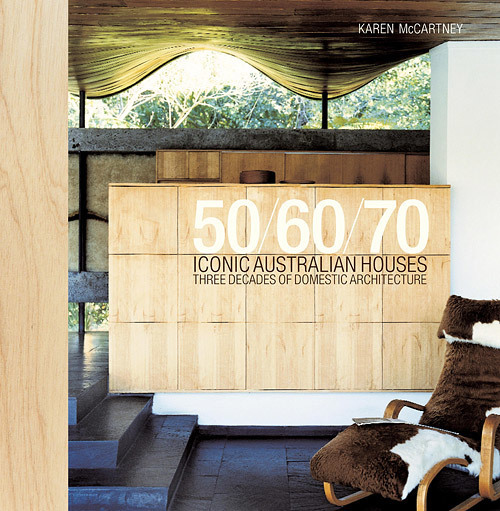
Karen McCartney introduces the soft back of her best-selling book 50/60/70 Iconic Australian Houses.
It was a very proud moment when I saw the soft-back reprint of '50/60/70 Iconic Australian Houses'. The book had had a good run in hardback, selling over thirteen thousand copies, and now the new version is a great price while maintaining the beautiful Japanese paper stock the original was printed on.
There is something about the period that continues to capture the public imagination as these houses were so radical in breaking from tradition and boldly explored what it is to be Australian in terms of responsiveness to climate, site and materials.
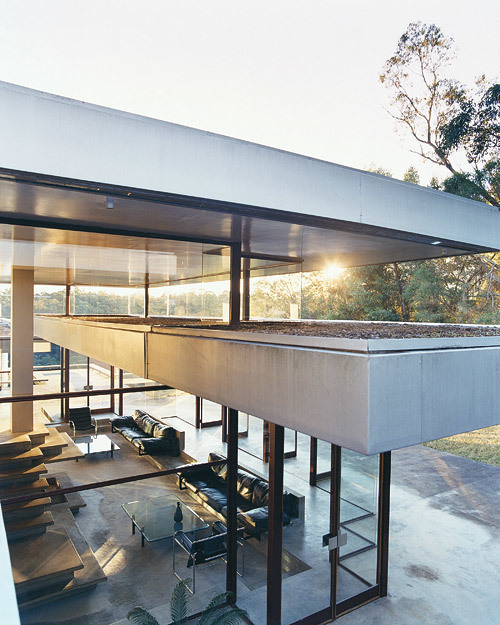
The Rosenburg/Hills house in Turramurra, designed in 1966 by architect Neville Gruzman overlooks a majestic bushland view. Image by Michael Wee.
The inventiveness of the architects never fails to amaze me often building on elevated sites as newly developed technologies opened up new ways to construct houses. Melbourne embraced structural geometry with triangular houses and circular courtyards within square walls while in Sydney's more temperate climate architects strove to link inside with out.
It is interesting to observe what was pioneering then, is commonplace now. The desire to be orientated north to maximise sunlight, our obsession with outdoors and the seamless passage from interior to exterior and the coming down of internal walls to create open-plan living spaces. All this was based on the work of these forward thinking architects.
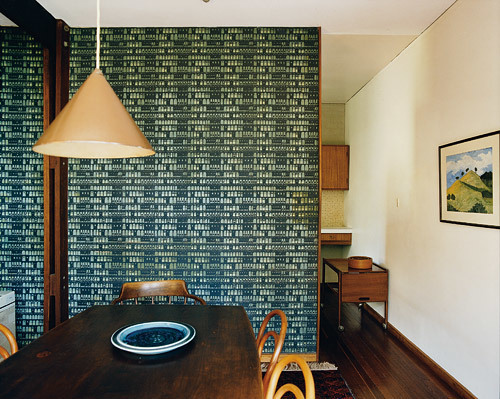
Architect Russell Jack's own home, designed in 1957 - the dining room still features the original wallpaper. Image by Michael Wee.
Of course I couldn't stop at the Seventies and the second book 70/80/90 Iconic Australian Houses revisited the Seventies for two reasons. Despite it being called 'the decade that style forgot' I found two of the best houses in Australia designed in that era – Richard Leplastrier's The Palm House and Glenn Murcutt's Kempsey House. The second reason was that iconic status takes a bit of time and when too close to a period it is hard to be clear about what should make the grade. I stopped at 2000 which some may say was still too close for comfort.
While the Seventies to the Nineties gets a bad press, aesthetically the houses in this second book are all beautiful and diverse with an inventiveness that matches the original book. We have a great culture of innovation in Australia, that isn't always about money, but is rather about ideas, how to exploit materials in an interesting way and how to pull in different cultural references, which we then adapt and make our own.
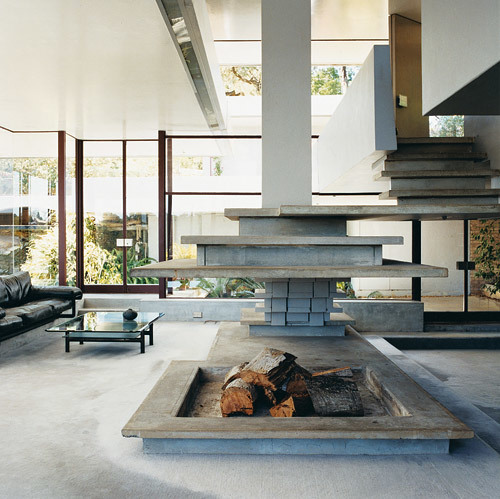
The fireplace in Gruzman's Rosenburg/Hills house combines functionality with a dramatic sculptural centrepiece. Image by Michael Wee.
Both books celebrate the extraordinary beauty of the Australian landscape as some architects integrate their building with the site and seek to create minimum disruption to nature, while others challenge it with assertive manmade structures. Either way it is to be celebrated.
The houses from the book are further explored in a forthcoming exhibition - 'Iconic Australian Houses' - at the Museum of Sydney from 12th April - 17th August 2014.
Karen McCartney's 50/60/70 Iconic Australian Houses
Karen McCartney introduces the soft back of her best-selling book 50/60/70 Iconic Australian Houses.
It was a very proud moment when I saw the soft-back reprint of '50/60/70 Iconic Australian Houses'. The book had had a good run in hardback, selling over thirteen thousand copies, and now the new version is a great price while maintaining the beautiful Japanese paper stock the original was printed on.
There is something about the period that continues to capture the public imagination as these houses were so radical in breaking from tradition and boldly explored what it is to be Australian in terms of responsiveness to climate, site and materials.
The Rosenburg/Hills house in Turramurra, designed in 1966 by architect Neville Gruzman overlooks a majestic bushland view. Image by Michael Wee.
The inventiveness of the architects never fails to amaze me often building on elevated sites as newly developed technologies opened up new ways to construct houses. Melbourne embraced structural geometry with triangular houses and circular courtyards within square walls while in Sydney's more temperate climate architects strove to link inside with out.
It is interesting to observe what was pioneering then, is commonplace now. The desire to be orientated north to maximise sunlight, our obsession with outdoors and the seamless passage from interior to exterior and the coming down of internal walls to create open-plan living spaces. All this was based on the work of these forward thinking architects.
Architect Russell Jack's own home, designed in 1957 - the dining room still features the original wallpaper. Image by Michael Wee.
Of course I couldn't stop at the Seventies and the second book 70/80/90 Iconic Australian Houses revisited the Seventies for two reasons. Despite it being called 'the decade that style forgot' I found two of the best houses in Australia designed in that era – Richard Leplastrier's The Palm House and Glenn Murcutt's Kempsey House. The second reason was that iconic status takes a bit of time and when too close to a period it is hard to be clear about what should make the grade. I stopped at 2000 which some may say was still too close for comfort.
While the Seventies to the Nineties gets a bad press, aesthetically the houses in this second book are all beautiful and diverse with an inventiveness that matches the original book. We have a great culture of innovation in Australia, that isn't always about money, but is rather about ideas, how to exploit materials in an interesting way and how to pull in different cultural references, which we then adapt and make our own.
The fireplace in Gruzman's Rosenburg/Hills house combines functionality with a dramatic sculptural centrepiece. Image by Michael Wee.
Both books celebrate the extraordinary beauty of the Australian landscape as some architects integrate their building with the site and seek to create minimum disruption to nature, while others challenge it with assertive manmade structures. Either way it is to be celebrated.
The houses from the book are further explored in a forthcoming exhibition - 'Iconic Australian Houses' - at the Museum of Sydney from 12th April - 17th August 2014.
Explore More








Head Office (No Showroom)
2/1-7 Unwins Bridge Rd, St Peters,
NSW 2044, Australia
Your customer reference #:
01-X-CSN