


Blog

Updated 17 February 2021
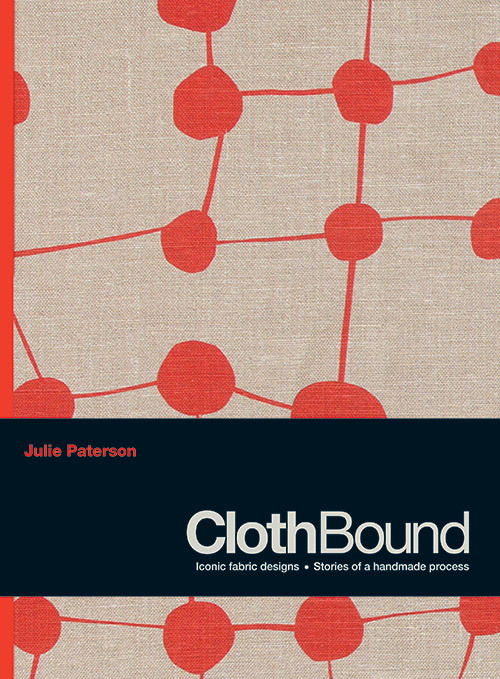
Artist and designer Julie Paterson, who started Cloth Fabric back in 1985, describes her new book, ClothBound, as an 'illustration of the daily practice that feeds my creative practice'. Karen McCartney finds out more about the inspiration behind Julie's work and her relationship with the Australian landscape.
I love that the title and the treatment of the book are one - in that the book is actually bound in cloth, making each book individual. How did that idea come about? And what does it say about you and your work?
I really wanted the book to be about my process and to be as authentic as possible. All my fabric is printed here in Australia, so I suggested to the publisher that I print the cover in the same way and with the same materials as I would normally do in my work, and they loved the idea. I resized the spot-check artwork to make the motif a little smaller, so that when it is attached to the book you get to experience the serendipity in the random order of the print. The irregularity means that the composition of the spots falls in a different placement for every book. I visualised the books together on bookshelves in the bookshops and thought it would have good visual appeal and say something quite unique.
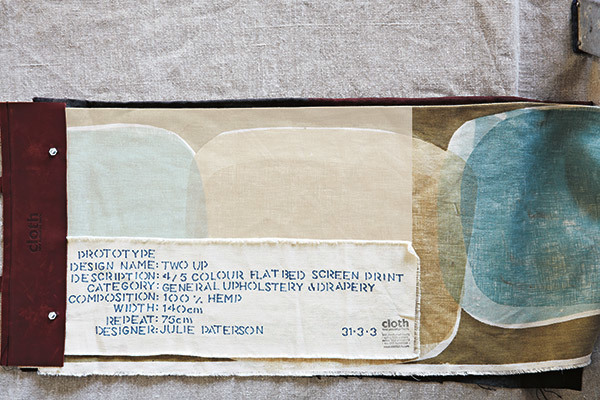
A prototype sample book of Julie's Two Up design, named for the Anzac Day game.
The book chronicles your creative journey through 8 different collections. In exploring each process, were you surprised by differences or comforted by similarities?
The thing that was so great to recognise was that all those ideas we had back in the early days still hold true today. The principles and approach are as strong as they ever were. I still use the same printer and makers as I did when I began. I use the same natural base-cloths and processes and feel as connected to the landscape in my work as I ever did. Writing this book has made me appreciate what we created back in those early days, and I have really seen my concepts strengthen and deepen through the process.
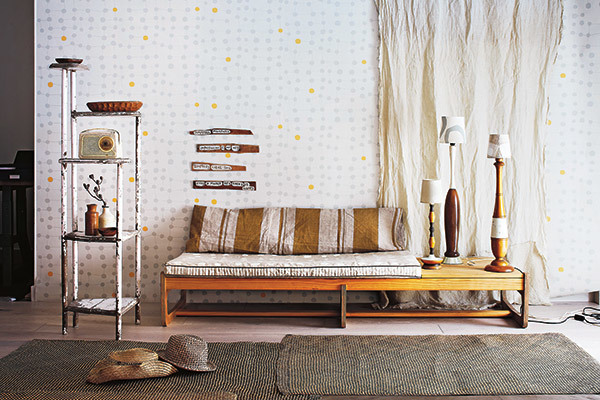
Julie's Spotcheck design in its wallpaper and fabric incarnations
The Australian landscape inspires much of your work. Do you think you see it through a different lens as you are originally from the UK?
The landscape I grew up with in the UK is the opposite of the landscape I know and love here. I have now lived in Australia longer than I lived in England. So now when I visit the UK it seems quite unfamiliar to me, just like Australia did in those first few years after arriving. So really, these days that lens is the same. I tend to look at my world with fresh eyes - observe and really look and record what I see, objectively. I try not to see what I think I know. These things are subtle but significant, and important to clarify.
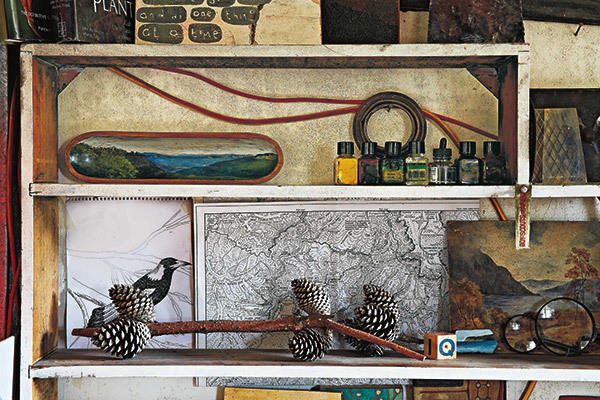
The long, thin landscape in a bowl (top left) is part of Julie's recent series of watercolours of famous views around the Blue Mountains.
Notebooks, watercolours, sketches, collecting thoughts, colours and ideas are an important part of your process. Why does this work for you?
It's about authenticity. I learnt a long time ago that documenting the small moments as I go through my day is a great approach to recording the unique and authentic story of my everyday life as it unfolds. Just walking the dog or going to get a pint of milk can offer up little gems of inspiration; stuff like a lovely early morning sky, a clarity of thought or a detail in the composition of the pavement that I had not thought of or noticed before will be there available for me and I like to remember it whilst I'm experiencing it.
There is nothing big or grand in making designs – it's all one-step at a time, everyday stuff. So a small sketchbook in my bag with a traveller's set of watercolours and a few coloured pencils is my simple kit for capturing those moments. These sketchbooks kick start the whole creative process later on when I'm back in the studio.
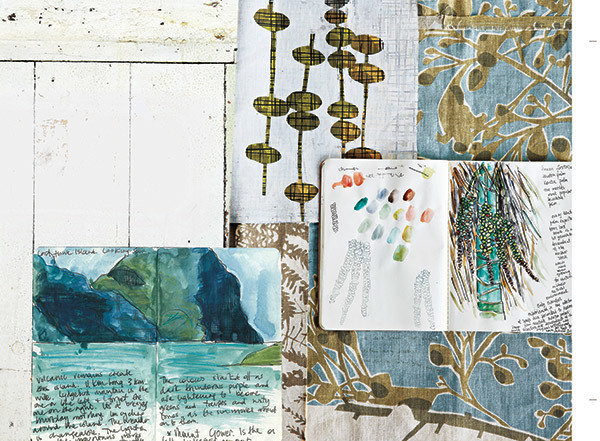
Julie's work for Capella Lodge on Lord Howe Island was inspired by the native kentia palm.
In the book you show two artworks side-by-side – one a sketch of the Devil's Marbles in the Northern Territory and one of topiary trees in front of a neighbour's house in the UK. They have a surprisingly similar look. Does this make you feel you have a very definite style that filters disparate elements into a strong, consistent visual statement?
I love those two images - I think they are very significant.
I do feel I have a strong style but it has grown as I've matured. Back when those paintings were made – in the year 2000 I think – I was still developing my style. I remember being struck by the similarity of the shapes when I made the pictures within a few weeks of each other. One was made by the action of the weather over time, the other by a suburban gardener's hands and a set of gardening shears. It was the different concept of time and the similar resulting organic shapes that got me thinking and recognising a connection between the two disparate places – suburban England and outback Australia. This is the stuff I love and is what I'm always seeking – these connections and their stories.
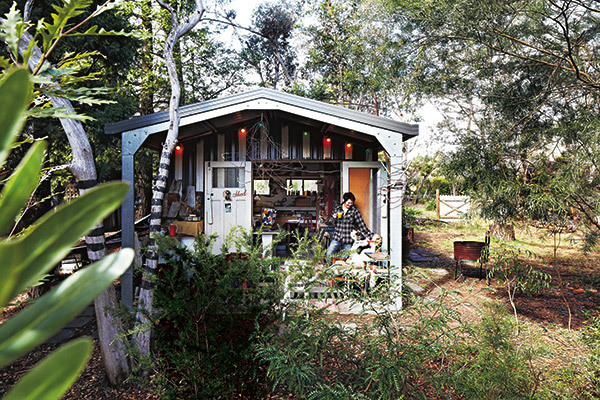
You work in a shed in the Blue Mountains. Is that an inspiring context for producing work that develops and cultivates the aesthetic of Cloth?
My shed is my haven - a place where I am truly myself. When I'm in my shed I'm focussed and in the flow. It's all about the flow! There are no distractions - just the birds, the weather, the dog and me – the phone doesn't even ring, as the reception is dodgy. This is all good; my work is all the richer for it.
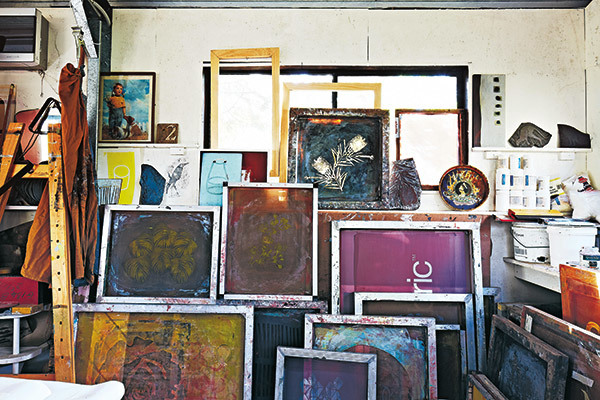
The 'grubby back corner' of Julie's shed, stacked up with layers of well-used silk screens.
Your work applies across the interiors spectrum – furnishing fabrics for upholstery, curtains, cushions, lampshades, wallpapers, rugs and artworks. Does this design diversity keep you engaged and excited about what is next?
Yes – I love collaborating. Working in various mediums means I can't do it all myself. I love having an idea and seeing where it might go; it keeps you on your creative toes and keeps you talking to people. This is important because deep down I suspect I'm a bit of a recluse. I could easily go for weeks without talking to anyone, so I curb this urge and I engage and connect through collaboration.
You have some exciting plans to promote the book through a back yard tour in your caravan. How can people find out more?
I'll be doing some farmers markets and popping up in friend's living rooms, studios and garages around the country, as well as doing a few pop-ups in my caravan. I'll be promoting where I pop up next via Instagram @clothjulie and on my website - juliepaterson.com.au
Images from ClothBound by Julie Paterson (Murdoch Books) $59.99, available in bookstores or online.
Update: Congratulations to Catherine N, the winner of a copy of Clothbound. This promotion is now closed.
Julie Paterson - ClothBound
Artist and designer Julie Paterson, who started Cloth Fabric back in 1985, describes her new book, ClothBound, as an 'illustration of the daily practice that feeds my creative practice'. Karen McCartney finds out more about the inspiration behind Julie's work and her relationship with the Australian landscape.
I love that the title and the treatment of the book are one - in that the book is actually bound in cloth, making each book individual. How did that idea come about? And what does it say about you and your work?
I really wanted the book to be about my process and to be as authentic as possible. All my fabric is printed here in Australia, so I suggested to the publisher that I print the cover in the same way and with the same materials as I would normally do in my work, and they loved the idea. I resized the spot-check artwork to make the motif a little smaller, so that when it is attached to the book you get to experience the serendipity in the random order of the print. The irregularity means that the composition of the spots falls in a different placement for every book. I visualised the books together on bookshelves in the bookshops and thought it would have good visual appeal and say something quite unique.
A prototype sample book of Julie's Two Up design, named for the Anzac Day game.
The book chronicles your creative journey through 8 different collections. In exploring each process, were you surprised by differences or comforted by similarities?
The thing that was so great to recognise was that all those ideas we had back in the early days still hold true today. The principles and approach are as strong as they ever were. I still use the same printer and makers as I did when I began. I use the same natural base-cloths and processes and feel as connected to the landscape in my work as I ever did. Writing this book has made me appreciate what we created back in those early days, and I have really seen my concepts strengthen and deepen through the process.
Julie's Spotcheck design in its wallpaper and fabric incarnations
The Australian landscape inspires much of your work. Do you think you see it through a different lens as you are originally from the UK?
The landscape I grew up with in the UK is the opposite of the landscape I know and love here. I have now lived in Australia longer than I lived in England. So now when I visit the UK it seems quite unfamiliar to me, just like Australia did in those first few years after arriving. So really, these days that lens is the same. I tend to look at my world with fresh eyes - observe and really look and record what I see, objectively. I try not to see what I think I know. These things are subtle but significant, and important to clarify.
The long, thin landscape in a bowl (top left) is part of Julie's recent series of watercolours of famous views around the Blue Mountains.
Notebooks, watercolours, sketches, collecting thoughts, colours and ideas are an important part of your process. Why does this work for you?
It's about authenticity. I learnt a long time ago that documenting the small moments as I go through my day is a great approach to recording the unique and authentic story of my everyday life as it unfolds. Just walking the dog or going to get a pint of milk can offer up little gems of inspiration; stuff like a lovely early morning sky, a clarity of thought or a detail in the composition of the pavement that I had not thought of or noticed before will be there available for me and I like to remember it whilst I'm experiencing it.
There is nothing big or grand in making designs – it's all one-step at a time, everyday stuff. So a small sketchbook in my bag with a traveller's set of watercolours and a few coloured pencils is my simple kit for capturing those moments. These sketchbooks kick start the whole creative process later on when I'm back in the studio.
Julie's work for Capella Lodge on Lord Howe Island was inspired by the native kentia palm.
In the book you show two artworks side-by-side – one a sketch of the Devil's Marbles in the Northern Territory and one of topiary trees in front of a neighbour's house in the UK. They have a surprisingly similar look. Does this make you feel you have a very definite style that filters disparate elements into a strong, consistent visual statement?
I love those two images - I think they are very significant.
I do feel I have a strong style but it has grown as I've matured. Back when those paintings were made – in the year 2000 I think – I was still developing my style. I remember being struck by the similarity of the shapes when I made the pictures within a few weeks of each other. One was made by the action of the weather over time, the other by a suburban gardener's hands and a set of gardening shears. It was the different concept of time and the similar resulting organic shapes that got me thinking and recognising a connection between the two disparate places – suburban England and outback Australia. This is the stuff I love and is what I'm always seeking – these connections and their stories.
You work in a shed in the Blue Mountains. Is that an inspiring context for producing work that develops and cultivates the aesthetic of Cloth?
My shed is my haven - a place where I am truly myself. When I'm in my shed I'm focussed and in the flow. It's all about the flow! There are no distractions - just the birds, the weather, the dog and me – the phone doesn't even ring, as the reception is dodgy. This is all good; my work is all the richer for it.
The 'grubby back corner' of Julie's shed, stacked up with layers of well-used silk screens.
Your work applies across the interiors spectrum – furnishing fabrics for upholstery, curtains, cushions, lampshades, wallpapers, rugs and artworks. Does this design diversity keep you engaged and excited about what is next?
Yes – I love collaborating. Working in various mediums means I can't do it all myself. I love having an idea and seeing where it might go; it keeps you on your creative toes and keeps you talking to people. This is important because deep down I suspect I'm a bit of a recluse. I could easily go for weeks without talking to anyone, so I curb this urge and I engage and connect through collaboration.
You have some exciting plans to promote the book through a back yard tour in your caravan. How can people find out more?
I'll be doing some farmers markets and popping up in friend's living rooms, studios and garages around the country, as well as doing a few pop-ups in my caravan. I'll be promoting where I pop up next via Instagram @clothjulie and on my website - juliepaterson.com.au
Images from ClothBound by Julie Paterson (Murdoch Books) $59.99, available in bookstores or online.
Update: Congratulations to Catherine N, the winner of a copy of Clothbound. This promotion is now closed.
Explore More



Payment options





Head Office (No Showroom)
2/1-7 Unwins Bridge Rd, St Peters,
NSW 2044, Australia
Your customer reference #:
01-X-CSN