



Updated 8 April 2021
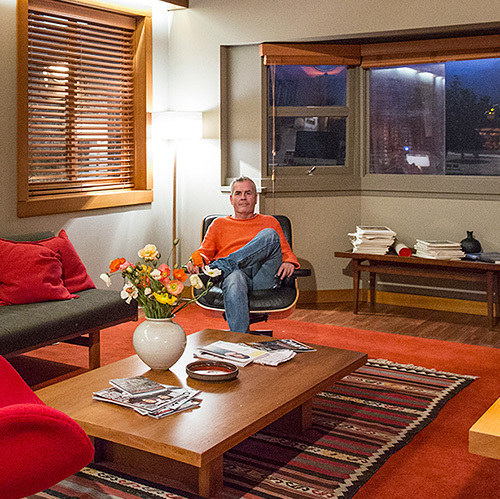
Karen McCartney goes behind the scenes with Sam Rickard (above), the creative force behind the look of Ten's new hit TV show Wonderland which airs on Wednesdays at 8.30pm. Read on for your chance to win 1 of 2 'Leve' chairs by designer Gary Galego, as seen in Tom's apartment.
Sam Rickard is the Production Designer on Ten's newest show Wonderland. It is a clever construct - five couples in an apartment building, each with a different set of relationship dynamics, playing out their emotional dramas in one of Sydney's coolest beachside suburbs.
Here Sam explains what it means to create distinctive sets that convey the nuances of each and every character.
Firstly - what does a production designer do?
A production designer interprets the scripts - be it a TV commercial, TV drama or film and determines, with the producer, what needs to be a set and what will be shot on location. They read about the characters and create sets that reflect their individual personalities. On a film you are responsible for the look of the whole production – the make-up and the wardrobe - whereas on TV it is mainly the set that you look after. The first thing you need to do is to assemble your team - an art department, an art director, prop buyers, set dressers, etc. All-in-all I have a team of 10-12 people for Wonderland.. The production designer collaborates with the producer, director and art department. To my mind the more collaboration the better the design.
Was this a challenging project because each set of characters requires their own distinctive space and look?
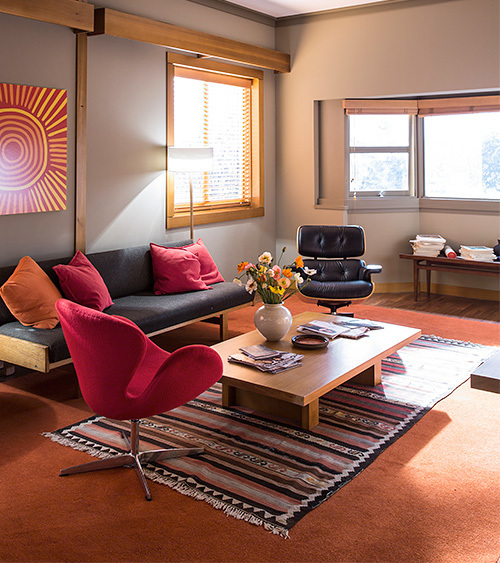
It was challenging from a time perspective but creatively it was great fun. We not only had to show each character's individuality but how they relate to one another. Sometimes to indicate the history of relationships I would have something move from one apartment to another. For example, Maggie and Tom are mother and son and Tom has a picture from his mother in his apartment. It helps to have some life experience and understand relationships and the way furniture and objects can shift around a family.
What is your creative process?
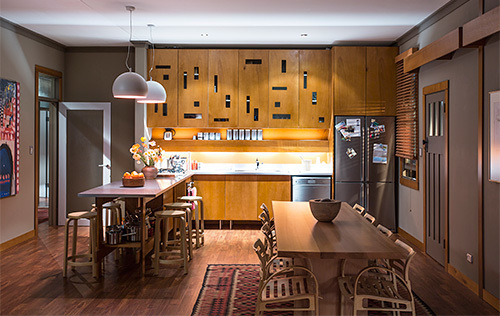
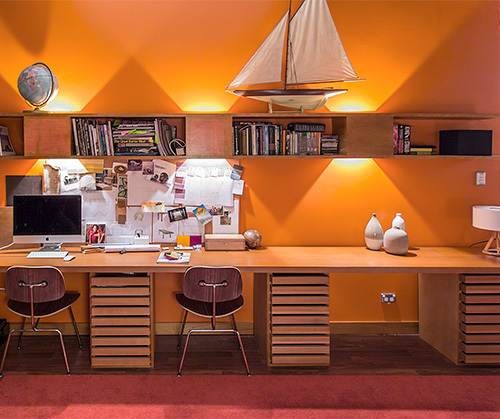
I do a lot of mood boards – firstly with tear sheets from magazines to show the producer, directors, prop buyers and set dressers what is in my head. I generally do a mood board for each set to indicate the direction. Then I send the prop buyers out to source items from auctions, vintage shops, eBay and even from the side of the road. Authenticity is very important to me and I like to source where real people do. We then do a real mood board with what we actually have and show it again and I justify my choices. The executive producer Jo Porter and I worked together on 'Packed to the Rafters'. She is very visual and challenges things and we debate what is right for the character. Sometimes she wins and sometimes I do – it is a collaboration.
Do you have a favourite character from an interior design perspective?
It is very rare for me to identify as closely as I do with Tom (Michael Dorman). He is a furniture designer and his history is very similar to mine so I got so into the character the set became me –it is completely my style. I designed the dining table and coffee table. I like eclectic timeless design and have used my original Eames lounge chair given to me by my dad in Tom's apartment
Did you draw on anyone else for Tom's visual sense?
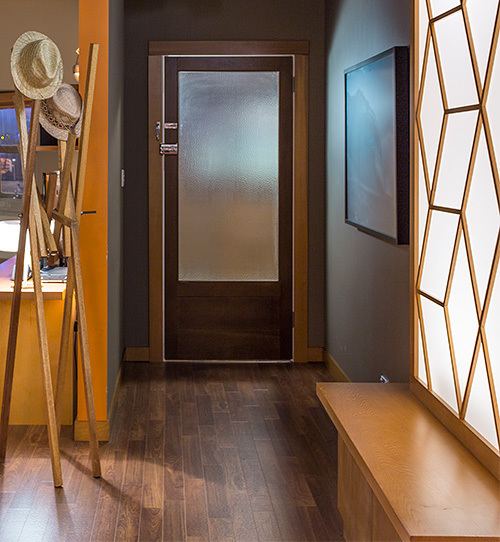
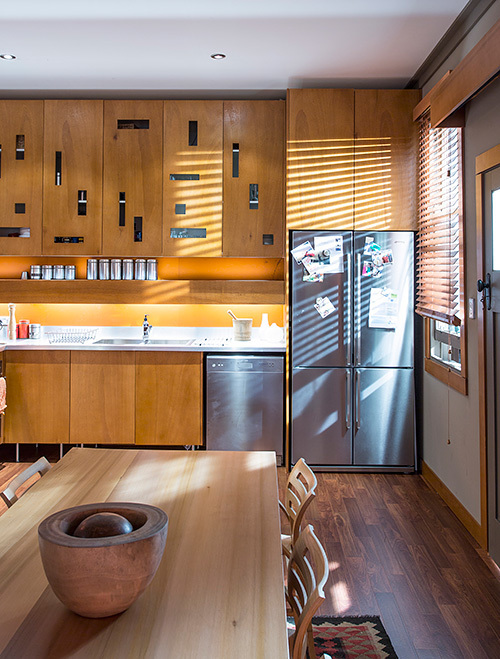
We were looking for young designer that could fit with Tom's character and had a studio space that would provide a basis for his workshop, and ended up working with Gary Galego. We got his maquettes and working models and photographed his wood working equipment and put that into the set and Gary became Tom. His timber pieces really suited Tom's apartment and we used his Leve chair to go with the table. When I met Gary I realized that I had used the chairs in a photo shoot of my home 10 years ago and Gary still had the photograph from the magazine.
Did you struggle with any of the apartment designs?
Yes – much as Tom was really easy for me, Dani and Steve's apartment was really hard. I couldn't quite get my head around them and their style and that is where I draw on others to help me get it right.
What level of detail do you go to in your sets?
I insist on real flowers not fake. They move, decay and fall apart in a way that fake flowers can't mimic. It is part of life and people notice these details.
What do you think makes you good at what you do?
Life experiences serve me well. You need to understand the psychology of a character and what will feel authentic and real to them. My father was an architect (Bruce Rickard) and my mother a psychologist and I am also an interior designer so all these attributes come to bear on the sets. Of course, sometime you feel something is wrong and have sleepless nights until you fix it. That is where collaboration comes in. You can draw on the experience of others to solve problems.
Does the constantly evolving storyline make for an interesting job?
I like to keep close to the writers to follow how the plot is evolving and what that means for the looks of the apartments. As life changes so does our home environment and it is important that is reflected in what surrounds the characters.
Tip for a smooth working life?
I am a big believer in having a conversation rather than email. I am a visual person and I like to look and talk. For one set I had done 5 or 6 different colour ways in blue and emails got us nowhere but when everyone got together we were able to decide quickly.
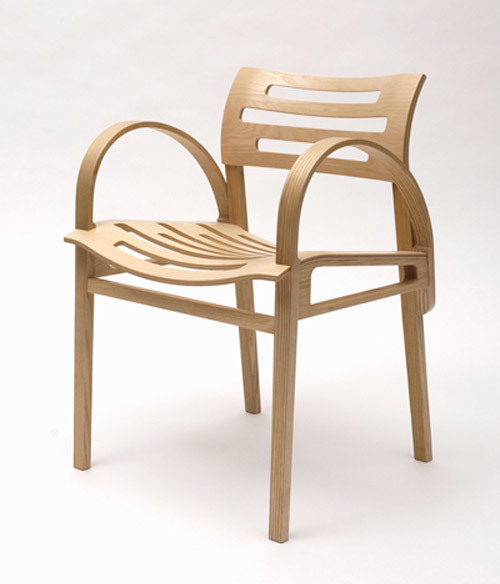
With thanks to Wonderland, we are delighted to offer you the chance to win 1 of 2 'Leve' chairs by talented Sydney designer Gary Galego. Worth over $500, the 'Leve' chair has hand-crafted appeal with its steam shaped arms and legs and moulded plywood seat and back and is finished in ash timber with a clear lacquer finish.
For your chance to win 1 of 2 'Leve' chairs by Gary Galego, tell us what you love about the Wonderland apartments by leaving a comment here on the blog before 5pm (AEST) on Tuesday 10 September 2013. You must be a member of Temple & Webster to enter, and you may only enter once. We will choose our two favourite comments, and will notify the winners via their Facebook pages or at the email addresses attached to their Temple & Webster account (if we are able to ascertain it) by Friday 20 September 2013. If we are unable to make contact with either or both winners via either of those methods within 30 days, we'll choose replacement winner(s). Good luck!
Competition closed.
Go behind the scenes on Ten's Wonderland
Karen McCartney goes behind the scenes with Sam Rickard (above), the creative force behind the look of Ten's new hit TV show Wonderland which airs on Wednesdays at 8.30pm. Read on for your chance to win 1 of 2 'Leve' chairs by designer Gary Galego, as seen in Tom's apartment.
Sam Rickard is the Production Designer on Ten's newest show Wonderland. It is a clever construct - five couples in an apartment building, each with a different set of relationship dynamics, playing out their emotional dramas in one of Sydney's coolest beachside suburbs.
Here Sam explains what it means to create distinctive sets that convey the nuances of each and every character.
Firstly - what does a production designer do?
A production designer interprets the scripts - be it a TV commercial, TV drama or film and determines, with the producer, what needs to be a set and what will be shot on location. They read about the characters and create sets that reflect their individual personalities. On a film you are responsible for the look of the whole production – the make-up and the wardrobe - whereas on TV it is mainly the set that you look after. The first thing you need to do is to assemble your team - an art department, an art director, prop buyers, set dressers, etc. All-in-all I have a team of 10-12 people for Wonderland.. The production designer collaborates with the producer, director and art department. To my mind the more collaboration the better the design.
Was this a challenging project because each set of characters requires their own distinctive space and look?
It was challenging from a time perspective but creatively it was great fun. We not only had to show each character's individuality but how they relate to one another. Sometimes to indicate the history of relationships I would have something move from one apartment to another. For example, Maggie and Tom are mother and son and Tom has a picture from his mother in his apartment. It helps to have some life experience and understand relationships and the way furniture and objects can shift around a family.
What is your creative process?
I do a lot of mood boards – firstly with tear sheets from magazines to show the producer, directors, prop buyers and set dressers what is in my head. I generally do a mood board for each set to indicate the direction. Then I send the prop buyers out to source items from auctions, vintage shops, eBay and even from the side of the road. Authenticity is very important to me and I like to source where real people do. We then do a real mood board with what we actually have and show it again and I justify my choices. The executive producer Jo Porter and I worked together on 'Packed to the Rafters'. She is very visual and challenges things and we debate what is right for the character. Sometimes she wins and sometimes I do – it is a collaboration.
Do you have a favourite character from an interior design perspective?
It is very rare for me to identify as closely as I do with Tom (Michael Dorman). He is a furniture designer and his history is very similar to mine so I got so into the character the set became me –it is completely my style. I designed the dining table and coffee table. I like eclectic timeless design and have used my original Eames lounge chair given to me by my dad in Tom's apartment
Did you draw on anyone else for Tom's visual sense?
We were looking for young designer that could fit with Tom's character and had a studio space that would provide a basis for his workshop, and ended up working with Gary Galego. We got his maquettes and working models and photographed his wood working equipment and put that into the set and Gary became Tom. His timber pieces really suited Tom's apartment and we used his Leve chair to go with the table. When I met Gary I realized that I had used the chairs in a photo shoot of my home 10 years ago and Gary still had the photograph from the magazine.
Did you struggle with any of the apartment designs?
Yes – much as Tom was really easy for me, Dani and Steve's apartment was really hard. I couldn't quite get my head around them and their style and that is where I draw on others to help me get it right.
What level of detail do you go to in your sets?
I insist on real flowers not fake. They move, decay and fall apart in a way that fake flowers can't mimic. It is part of life and people notice these details.
What do you think makes you good at what you do?
Life experiences serve me well. You need to understand the psychology of a character and what will feel authentic and real to them. My father was an architect (Bruce Rickard) and my mother a psychologist and I am also an interior designer so all these attributes come to bear on the sets. Of course, sometime you feel something is wrong and have sleepless nights until you fix it. That is where collaboration comes in. You can draw on the experience of others to solve problems.
Does the constantly evolving storyline make for an interesting job?
I like to keep close to the writers to follow how the plot is evolving and what that means for the looks of the apartments. As life changes so does our home environment and it is important that is reflected in what surrounds the characters.
Tip for a smooth working life?
I am a big believer in having a conversation rather than email. I am a visual person and I like to look and talk. For one set I had done 5 or 6 different colour ways in blue and emails got us nowhere but when everyone got together we were able to decide quickly.
With thanks to Wonderland, we are delighted to offer you the chance to win 1 of 2 'Leve' chairs by talented Sydney designer Gary Galego. Worth over $500, the 'Leve' chair has hand-crafted appeal with its steam shaped arms and legs and moulded plywood seat and back and is finished in ash timber with a clear lacquer finish.
For your chance to win 1 of 2 'Leve' chairs by Gary Galego, tell us what you love about the Wonderland apartments by leaving a comment here on the blog before 5pm (AEST) on Tuesday 10 September 2013. You must be a member of Temple & Webster to enter, and you may only enter once. We will choose our two favourite comments, and will notify the winners via their Facebook pages or at the email addresses attached to their Temple & Webster account (if we are able to ascertain it) by Friday 20 September 2013. If we are unable to make contact with either or both winners via either of those methods within 30 days, we'll choose replacement winner(s). Good luck!
Competition closed.
Explore More








Head Office (No Showroom)
2/1-7 Unwins Bridge Rd, St Peters,
NSW 2044, Australia
Your customer reference #:
01-X-CSN