



Updated 27 May 2021
Know your classics: Marc Newson - High Flyer
Have you been admiring the sleek design of the Noritake dinnerware designed by Marc Newson in today's feature? We are lucky to have design expert Monique Rappell back to put Marc Newson's work in perspective for us.
The heroes of yesteryear were pilots ranging from the Wright
brothers to our own Kingsford Smith, or the American Amelia Earhart. They flew
the world taking risks with their own lives that mere mortals could not imagine
or afford. Flight inspired a sense of courage, luxury, and glamour which has
only recently returned to airborne travel.
In the 1980s design appropriated the notion of the glamorous
hero and invented the 'hero designer', usually an industrial designer whose
name could sell anything from a bottle opener to a hotel. The problem was that you
often paid for the name and novelty, for difference not for functional design.
A classic example is the Juicy Salif designed by Philippe Starck (1990). Sorry
Philippe, but who needs a juicer shaped like a rocket that corrodes when
exposed to lemon juice? If you have a Juicy - don't despair. At the time it
meant you were forward thinking and a risk taker, much like an early aviator.
Jump forward twenty years and heroic design now has a social
conscience and a political agenda. Heroic design has more to do with social
innovation than product. Yet one designer stands out who has the qualities of a
fearless aviator and the daring of a late 1980s hero designer.
Marc Newson is Australia's own wunderkind design export. He
began his career in the early 1990s and has been internationally regarded ever
since. The fascinating thing about Newson is not the breadth and diversity of
his talent and output, but his obvious fascination and close ties with the
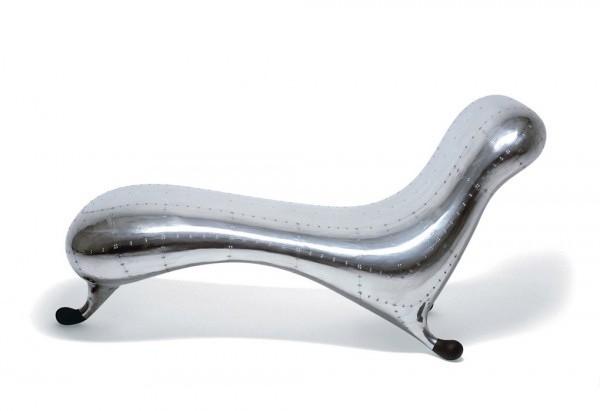
aviation industry. Newson's notoriety began with his unique Lockheed lounge
(1993), a curved chaise lounge 'upholstered' with hand riveted
aluminium sheet - a nod to an earlier romantic era of flight. Seen
draped by Madonna in the filmclip to "Rain", it is both sensual and
otherworldly. Only made in a very limited edition, it now sells for millions.
Newson may be the only designer in the world to design the
interiors of private Lear jets, commercial airlines' interiors including
Qantas' A380, first class flight lounge interiors and first class in flight
table ceramics with the company Noritake. While Noritake have worked with
Qantas for 25 years, Newson brought a modern quality to their work only six
years ago. His designs, unlike the whimsy of earlier hero designers, are both
elegant and functional. They bring a sense of modern sensuality to a formidably
tricky environment. The trick to designing for first class flight is of course
to perform under extreme conditions without losing the quality of glamour of
much less arduous environs. Newson has without doubt contributed to a
resurgence in the glamour of flying. His forms offer comforting stability,
futuristic form and absolute quality.
The heroes of yesteryear were pilots ranging from the Wright
brothers to our own Kingsford Smith, or the American Amelia Earhart. They flew
the world taking risks with their own lives that mere mortals could not imagine
or afford. Flight inspired a sense of courage, luxury, and glamour which has
only recently returned to airborne travel.
In the 1980s design appropriated the notion of the glamorous
hero and invented the 'hero designer', usually an industrial designer whose
name could sell anything from a bottle opener to a hotel. The problem was that you
often paid for the name and novelty, for difference not for functional design.
A classic example is the Juicy Salif designed by Philippe Starck (1990). Sorry
Philippe, but who needs a juicer shaped like a rocket that corrodes when
exposed to lemon juice? If you have a Juicy - don't despair. At the time it
meant you were forward thinking and a risk taker, much like an early aviator.
Jump forward twenty years and heroic design now has a social
conscience and a political agenda. Heroic design has more to do with social
innovation than product. Yet one designer stands out who has the qualities of a
fearless aviator and the daring of a late 1980s hero designer.
Marc Newson is Australia's own wunderkind design export. He
began his career in the early 1990s and has been internationally regarded ever
since. The fascinating thing about Newson is not the breadth and diversity of
his talent and output, but his obvious fascination and close ties with the
aviation industry. Newson's notoriety began with his unique Lockheed lounge
(1993), a curved chaise lounge 'upholstered' with hand riveted
aluminium sheet - a nod to an earlier romantic era of flight. Seen
draped by Madonna in the filmclip to "Rain", it is both sensual and
otherworldly. Only made in a very limited edition, it now sells for millions.
Newson may be the only designer in the world to design the
interiors of private Lear jets, commercial airlines' interiors including
Qantas' A380, first class flight lounge interiors and first class in flight
table ceramics with the company Noritake. While Noritake have worked with
Qantas for 25 years, Newson brought a modern quality to their work only six
years ago. His designs, unlike the whimsy of earlier hero designers, are both
elegant and functional. They bring a sense of modern sensuality to a formidably
tricky environment. The trick to designing for first class flight is of course
to perform under extreme conditions without losing the quality of glamour of
much less arduous environs. Newson has without doubt contributed to a
resurgence in the glamour of flying. His forms offer comforting stability,
futuristic form and absolute quality.
Explore More








Head Office (No Showroom)
2/1-7 Unwins Bridge Rd, St Peters,
NSW 2044, Australia
Your customer reference #:
01-X-CSN