



Updated 24 May 2021
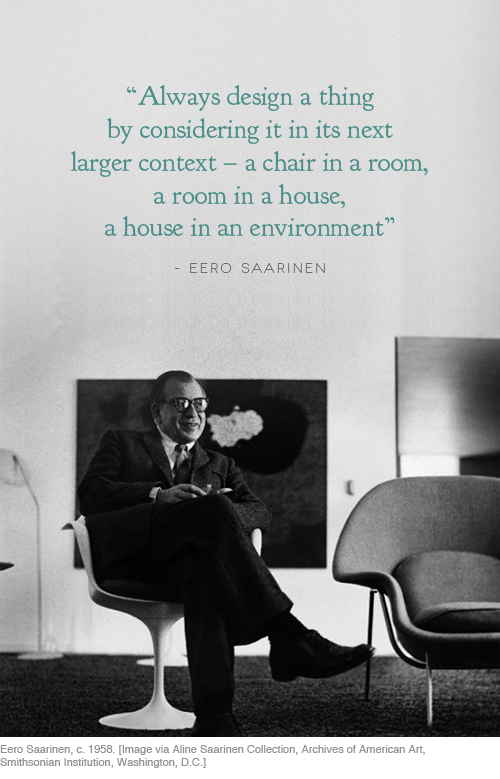
From armchairs to airports, Eero Saarinen (1910 – 1961) was a master of design with an influence that is still apparent today. He even played a key role in our iconic Sydney Opera House. Design aficionado David Harrison writes for us about a truly visionary designer.
Who was he?
Saarinen came from a family of designers – his mother Loja was a sculptor and textile designer, his father Eliel, an architect. Born in 1910 in Finland, he emigrated to the USA with his parents when he was 13. Eliel was a highly regarded architect in Finland who soon after arriving in America was commissioned to design the buildings for a new design and architecture school, Cranbrook Academy of Art, in Michigan. Although Eero graduated in architecture at Yale in 1934, it was his association with lecturers at Cranbrook that led to his success in furniture early on in his career.
A host of highly talented designers were lecturing at Cranbrook; Harry Bertoia, Florence Knoll, Ralph Rapson and most importantly for Eero, Charles Eames. It was a joint project with Eames - a collection of tables chairs and sideboards – that was to bring both designers' names to public attention. The pair entered the 1940 Museum of Modern Art's 'Organic Design in Home Furnishings' and won two first prizes. Both went on to draw on the ideas and concepts explored in their competition entries when designing similar, hugely successful chair designs a few years later.
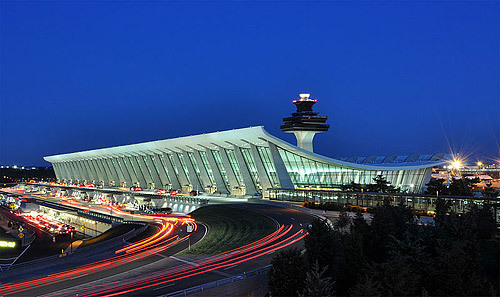
Saarinen's furniture designs from this period are still in production and have become icons of 20th century design, but ultimately architecture was to remain his focus. With many of America's most famous 20th century buildings to his name, Saarinen signature works include the TWA terminal building at JFK airport New York, the Dulles International Airport in Virginia (above) and the amazing St Louis Gateway Arch, Missouri designed in 1947 but only built in 1963. All three show Saarinen's totally visionary approach to form. Saarinen died suddenly at the age of 51 due to a brain tumour.
What is he best known for?

The 'Tulip' tables (see above) and matching chairs (not shown) designed in 1955 for Knoll International New York. Made from smooth white fibreglass and white nylon-coated spun aluminium, the entire range utilises a single hourglass-style pedestal base instead of individual legs. This revolutionary approach has been much copied since but was totally unprecedented at the time. Saarinen once commented on the design "I wanted to clear up the slum of legs."

The Womb chair (above), originally called the Model 70 but rapidly known as the Womb chair for its body hugging shape and high comfort factor. Made from plywood wrapped in foam and upholstery with two removable seat and back cushions, the chair offers ample room to move around in and was seen as a break away from the conventions of strictness of normal seating. Designed in 1947, it has been produced from 1948 until the present.

The 'Organic' chair (above), designed with Charles Eames, was one of the winning entries in MOMA's 'Organic Design in Home Furnishings' competition in 1940. Designed in 1940, the chair remained a prototype until 2008 when it was finally put into production by Swiss manufacturer Vitra. A forerunner to the larger cocoon-like Womb chair, it uses many of the same techniques and materials but in an occasional chair format.
What are the hallmarks of a Saarinen design?
Influenced by his mother's background in sculpture, Saarinen studied sculpture in Paris before beginning his architectural degree at Yale. This interest in the sculptural possibilities of all objects, from furniture designs like his 'Tulip' series for Knoll to giant public buildings, was the driving force behind his work. His free use of radical concepts can be seen in buildings like his Dulles International Airport near Washington D.C. (see below) which creates a hugely energetic architectural language. Its massive sweeping concrete roof with outward leaning columns and giant concave glass walls are a magnificent architectural expression of the principles of flight.
Fascinating Fact
It was, allegedly, Eero Saarinen that saved Jørn Utzon's Sydney Opera House concept from the reject pile during the competition judging in 1957. Arriving late to the selection process, Saarinen sifted through the designs already discarded by the other judges and enthusiastically embraced Utzon's concept, declaring it to be outstanding.
Know your classics - Eero Saarinen
From armchairs to airports, Eero Saarinen (1910 – 1961) was a master of design with an influence that is still apparent today. He even played a key role in our iconic Sydney Opera House. Design aficionado David Harrison writes for us about a truly visionary designer.
Who was he?
Saarinen came from a family of designers – his mother Loja was a sculptor and textile designer, his father Eliel, an architect. Born in 1910 in Finland, he emigrated to the USA with his parents when he was 13. Eliel was a highly regarded architect in Finland who soon after arriving in America was commissioned to design the buildings for a new design and architecture school, Cranbrook Academy of Art, in Michigan. Although Eero graduated in architecture at Yale in 1934, it was his association with lecturers at Cranbrook that led to his success in furniture early on in his career.
A host of highly talented designers were lecturing at Cranbrook; Harry Bertoia, Florence Knoll, Ralph Rapson and most importantly for Eero, Charles Eames. It was a joint project with Eames - a collection of tables chairs and sideboards – that was to bring both designers' names to public attention. The pair entered the 1940 Museum of Modern Art's 'Organic Design in Home Furnishings' and won two first prizes. Both went on to draw on the ideas and concepts explored in their competition entries when designing similar, hugely successful chair designs a few years later.
Saarinen's furniture designs from this period are still in production and have become icons of 20th century design, but ultimately architecture was to remain his focus. With many of America's most famous 20th century buildings to his name, Saarinen signature works include the TWA terminal building at JFK airport New York, the Dulles International Airport in Virginia (above) and the amazing St Louis Gateway Arch, Missouri designed in 1947 but only built in 1963. All three show Saarinen's totally visionary approach to form. Saarinen died suddenly at the age of 51 due to a brain tumour.
What is he best known for?
Source: iainclaridge.co.uk via Modern on Pinterest
The 'Tulip' tables (see above) and matching chairs (not shown) designed in 1955 for Knoll International New York. Made from smooth white fibreglass and white nylon-coated spun aluminium, the entire range utilises a single hourglass-style pedestal base instead of individual legs. This revolutionary approach has been much copied since but was totally unprecedented at the time. Saarinen once commented on the design "I wanted to clear up the slum of legs."
The Womb chair (above), originally called the Model 70 but rapidly known as the Womb chair for its body hugging shape and high comfort factor. Made from plywood wrapped in foam and upholstery with two removable seat and back cushions, the chair offers ample room to move around in and was seen as a break away from the conventions of strictness of normal seating. Designed in 1947, it has been produced from 1948 until the present.
Source: thedesignfiles.net via Karryn on Pinterest
The 'Organic' chair (above), designed with Charles Eames, was one of the winning entries in MOMA's 'Organic Design in Home Furnishings' competition in 1940. Designed in 1940, the chair remained a prototype until 2008 when it was finally put into production by Swiss manufacturer Vitra. A forerunner to the larger cocoon-like Womb chair, it uses many of the same techniques and materials but in an occasional chair format.
What are the hallmarks of a Saarinen design?
Influenced by his mother's background in sculpture, Saarinen studied sculpture in Paris before beginning his architectural degree at Yale. This interest in the sculptural possibilities of all objects, from furniture designs like his 'Tulip' series for Knoll to giant public buildings, was the driving force behind his work. His free use of radical concepts can be seen in buildings like his Dulles International Airport near Washington D.C. (see below) which creates a hugely energetic architectural language. Its massive sweeping concrete roof with outward leaning columns and giant concave glass walls are a magnificent architectural expression of the principles of flight.
Fascinating Fact
It was, allegedly, Eero Saarinen that saved Jørn Utzon's Sydney Opera House concept from the reject pile during the competition judging in 1957. Arriving late to the selection process, Saarinen sifted through the designs already discarded by the other judges and enthusiastically embraced Utzon's concept, declaring it to be outstanding.
Explore More








Head Office (No Showroom)
2/1-7 Unwins Bridge Rd, St Peters,
NSW 2044, Australia
Your customer reference #:
01-X-CSN