



Updated 8 April 2021
Karen McCartney shares her favourite finds by new and established designers from the London Design Festival 2013.
The London Design Festival runs annually in September and this year celebrated its 11th anniversary with a remarkable display of events, trade shows, talks, debates, installations and pop-ups. The theme was 'Design Is Everywhere' and the reality lived up to the promise as small designer/makers rubbed shoulders with big international design brands. I gathered a lot of material so it was hard to drill down to a mere 14, but here are some deserving favourites.
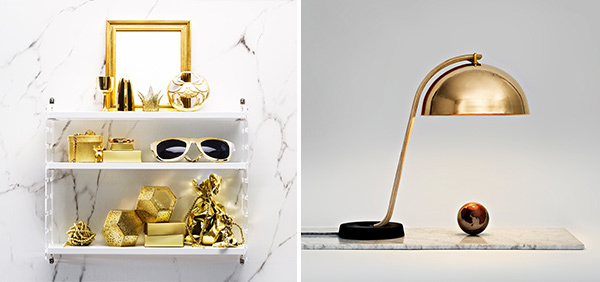
String pocket (left) is the smallest design in the string range, which was design by Swedish architect Nils Strinning in 1949. A minimal shelving system, it can grow to fill a whole kitchen or study wall or shrink to this small, discreet shelving unit. All their images are beautifully and inventively styled to showcase the sheer versatility of the range, which is available in Australia through Great Dane. 100% Norway has had a presence at the London Design Festival for 10 years and celebrated by taking a 10 x 10 approach - 10 designers looking back and 10 looking forward. Lars Beller Fjetland, while heralding part of Norway's creative future, looks to the past in his light design - Cloche (right). Influenced by the industrial designs of the 1930s and 1940s, and with a construction approach taken from traditional hammers and axes, his 3-part flat pack design embodies an intelligent way of approaching the future – by drawing on the best of the past.
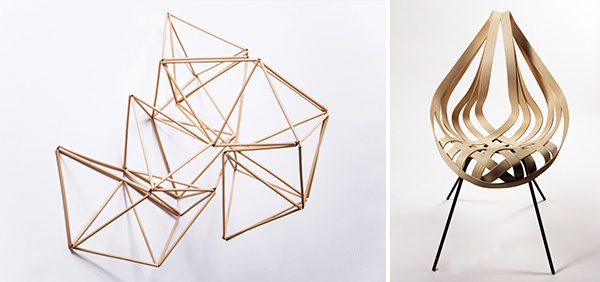
Mie Matsubara's geometric wall sculptures (left) are fragile and intricate yet have a definite presence. Mie has used bamboo sticks, from Western Japan, originally intended for use in the manufacture of ink brushes, and fashioned them into a 3-dimensional sculptural piece. The Saji Chair by Laura Kishimoto (right) is a skilful design execution in bent laminated ash and mild steel. Her aim was to 'instil a sense of movement in the overall composition'. It is a chair that is equally impressive from all angles.
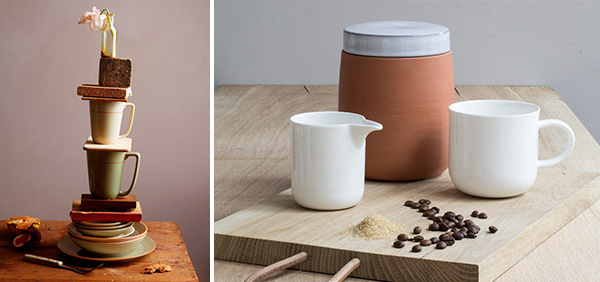
Rustikk tableware (left) is the latest range from successful design duo Wik & Walsøe who showed at 100% Norway as part of the design heritage selection. These hand-painted, hand-glazed vessels and plates are created using pure, natural, lead-free and sustainable materials. The colours – warm olive, intense coral and a delicate beige - sit comfortably together. (Right) Sue Pryke has returned to her roots as a designer maker after many years designing ranges for the world's most prestigious home wares stores. Working with traditional potteries in Stoke-on-Trent and local carpenters, Sue places the emphasis on the material qualities of terracotta, oak and pewter to produce timeless pieces with a pared back aesthetic.
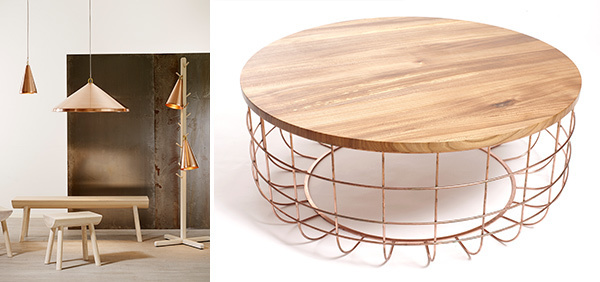
(Left) Copper is very much the material du jour and here looks even shinier and smarter as it is paired with benches and stools in a matt, light ash. Ola Wihlborg has designed many successful products for IKEA but these refined products are his personal work. (Right) This coffee table by Dare Studio has a copper wire base and timber top, successfully combining the contrasting elements openness and solidity. Sizes and heights vary and new additions to the range include marble and granite tops.
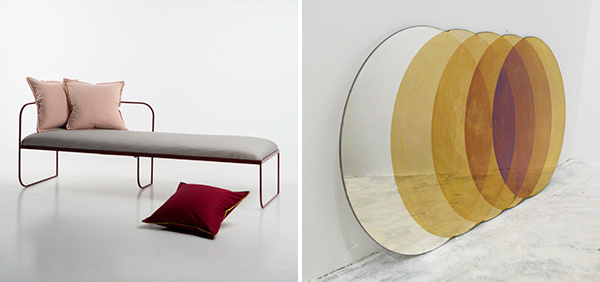
I realise that there is a bit of bias towards the Scandinavian countries in this report but they are just so good and Vera & Kyte, from Norway, are no exception. Take their elegant daybed, Balcony (left), a combination of the spare elegance of a steel form with plump, comfortable cushions in dusty pink and claret. Other products have great names – a hanging light is called Bobby & Bandit and a mirror range with slices of candy colour is goes by the name Popsicle. Mirrors are undergoing a design rethink and one of the most exciting executions is that of the, Transience Mirrors, by Lex Pott and David Derksen (right). Exploiting geometric shapes, this design duo explore the process of oxidisation, controlling it to create these impactful graduated colour effects in gold and brown.
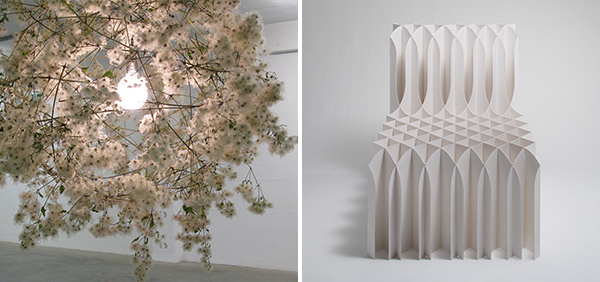
This magical light by Jess Shaw (left) was one of the first things I saw when I arrived at Tent London. Shaw is an artist who works with nature and natural concepts – often bringing water and feathers into her executions. This large suspended nest-like structure is created from a plant called 'Old Man's Beard" and looks as though has been shaped by a large stylish bird. The 'Watching You Chair' (right) uses folded paper which is cut and formed in a series of modules which fit together to form a sturdy chair or bench. Sekita Design Studio is Tokyo-based, as befits this sculptural origami furniture.
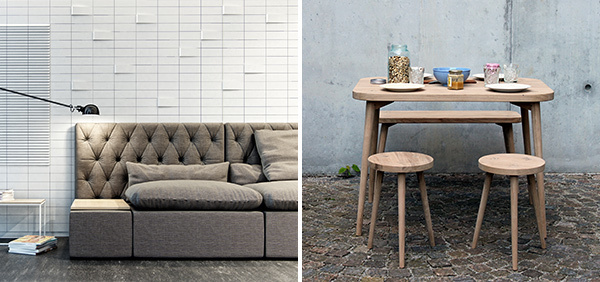
(Left) Erica Wakerly, known for experimental wallpaper designs, has taken on the third dimension. Working with Kaza Concrete she has developed a range called Form Wall tiles which create interesting relief patterns according to their arrangement. (Right) My favourite stand was The Cold Press, a Norfolk gallery which curates objects and artworks. They have a fine, discerning eye and a feel for the natural crafted piece. These simple Asta stools by Karin Ekwall ulitise traditional Scandinavian furniture techniques. I was very grateful that co- owner Ben Lawrence was able to sell me two vessels in blackened sycamore by the talented Tim Willey. See his processes at www.timwilley.com. He is quietly inspiring.
Karen McCartney visits the London Design Festival
Karen McCartney shares her favourite finds by new and established designers from the London Design Festival 2013.
The London Design Festival runs annually in September and this year celebrated its 11th anniversary with a remarkable display of events, trade shows, talks, debates, installations and pop-ups. The theme was 'Design Is Everywhere' and the reality lived up to the promise as small designer/makers rubbed shoulders with big international design brands. I gathered a lot of material so it was hard to drill down to a mere 14, but here are some deserving favourites.
String pocket (left) is the smallest design in the string range, which was design by Swedish architect Nils Strinning in 1949. A minimal shelving system, it can grow to fill a whole kitchen or study wall or shrink to this small, discreet shelving unit. All their images are beautifully and inventively styled to showcase the sheer versatility of the range, which is available in Australia through Great Dane. 100% Norway has had a presence at the London Design Festival for 10 years and celebrated by taking a 10 x 10 approach - 10 designers looking back and 10 looking forward. Lars Beller Fjetland, while heralding part of Norway's creative future, looks to the past in his light design - Cloche (right). Influenced by the industrial designs of the 1930s and 1940s, and with a construction approach taken from traditional hammers and axes, his 3-part flat pack design embodies an intelligent way of approaching the future – by drawing on the best of the past.
Mie Matsubara's geometric wall sculptures (left) are fragile and intricate yet have a definite presence. Mie has used bamboo sticks, from Western Japan, originally intended for use in the manufacture of ink brushes, and fashioned them into a 3-dimensional sculptural piece. The Saji Chair by Laura Kishimoto (right) is a skilful design execution in bent laminated ash and mild steel. Her aim was to 'instil a sense of movement in the overall composition'. It is a chair that is equally impressive from all angles.
Rustikk tableware (left) is the latest range from successful design duo Wik & Walsøe who showed at 100% Norway as part of the design heritage selection. These hand-painted, hand-glazed vessels and plates are created using pure, natural, lead-free and sustainable materials. The colours – warm olive, intense coral and a delicate beige - sit comfortably together. (Right) Sue Pryke has returned to her roots as a designer maker after many years designing ranges for the world's most prestigious home wares stores. Working with traditional potteries in Stoke-on-Trent and local carpenters, Sue places the emphasis on the material qualities of terracotta, oak and pewter to produce timeless pieces with a pared back aesthetic.
(Left) Copper is very much the material du jour and here looks even shinier and smarter as it is paired with benches and stools in a matt, light ash. Ola Wihlborg has designed many successful products for IKEA but these refined products are his personal work. (Right) This coffee table by Dare Studio has a copper wire base and timber top, successfully combining the contrasting elements openness and solidity. Sizes and heights vary and new additions to the range include marble and granite tops.
I realise that there is a bit of bias towards the Scandinavian countries in this report but they are just so good and Vera & Kyte, from Norway, are no exception. Take their elegant daybed, Balcony (left), a combination of the spare elegance of a steel form with plump, comfortable cushions in dusty pink and claret. Other products have great names – a hanging light is called Bobby & Bandit and a mirror range with slices of candy colour is goes by the name Popsicle. Mirrors are undergoing a design rethink and one of the most exciting executions is that of the, Transience Mirrors, by Lex Pott and David Derksen (right). Exploiting geometric shapes, this design duo explore the process of oxidisation, controlling it to create these impactful graduated colour effects in gold and brown.
This magical light by Jess Shaw (left) was one of the first things I saw when I arrived at Tent London. Shaw is an artist who works with nature and natural concepts – often bringing water and feathers into her executions. This large suspended nest-like structure is created from a plant called 'Old Man's Beard" and looks as though has been shaped by a large stylish bird. The 'Watching You Chair' (right) uses folded paper which is cut and formed in a series of modules which fit together to form a sturdy chair or bench. Sekita Design Studio is Tokyo-based, as befits this sculptural origami furniture.
(Left) Erica Wakerly, known for experimental wallpaper designs, has taken on the third dimension. Working with Kaza Concrete she has developed a range called Form Wall tiles which create interesting relief patterns according to their arrangement. (Right) My favourite stand was The Cold Press, a Norfolk gallery which curates objects and artworks. They have a fine, discerning eye and a feel for the natural crafted piece. These simple Asta stools by Karin Ekwall ulitise traditional Scandinavian furniture techniques. I was very grateful that co- owner Ben Lawrence was able to sell me two vessels in blackened sycamore by the talented Tim Willey. See his processes at www.timwilley.com. He is quietly inspiring.
Explore More








Head Office (No Showroom)
2/1-7 Unwins Bridge Rd, St Peters,
NSW 2044, Australia
Your customer reference #:
01-X-CSN