



Updated 29 March 2021
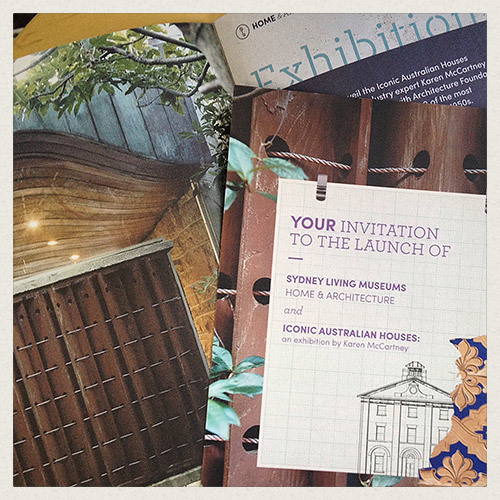
Karen McCartney gives an insight into the development of her Iconic Australian Houses exhibition, running at the Museum of Sydney until August 17.
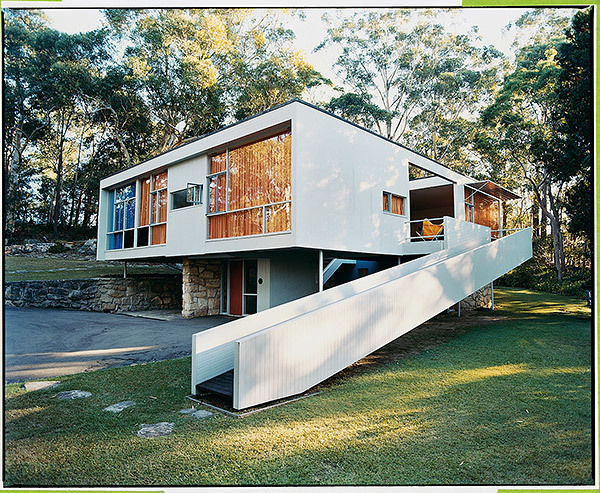
Rose Seidler House, architect Harry Seidler. Photograph © Michael Wee.
It is a rare opportunity to be able to curate an exhibition and have the experience of working with the team at Sydney Living Museums to produce a show that is small but perfectly formed, on a subject close to your heart.
I am a great believer that in order to be the recipient of opportunity you need to put yourself in its way, and I feel fortunate that the work put into researching and writing two books '50/60/70 Iconic Australian Houses' and its sequel '70/80/90 iconic Australian Houses' has found another expression in this exhibition.
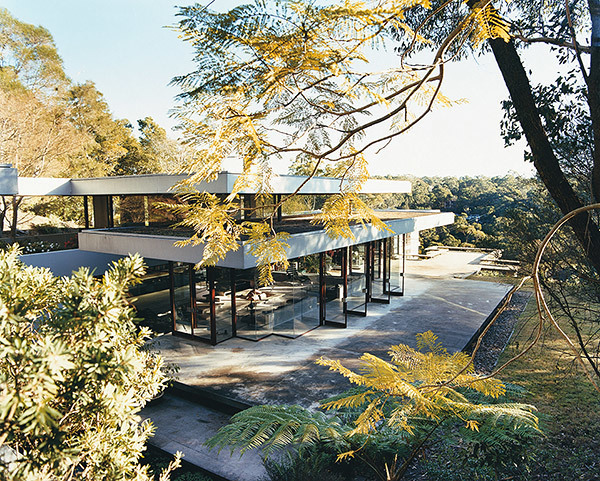
The Rosenburg/Hills House, architect Neville Gruzman. Photograph © Michael Wee
As chance would have it I met architect, and convenor of the Architecture Foundation of Australia, Lindsay Johnston because I sold him some of the aforesaid books for his students at the Glenn Murcutt Master Classes. I wrapped them in brown paper and left them at the Brooklyn Marina for him to pick up in his tinnie, from his home in the Hawkesbury River.
When we did get talking we discovered we both hailed from Northern Ireland and had a shared history. He had produced a very successful exhibition on the work of Glenn Murcutt which had launched at the Museum of Sydney and then travelled the world. What if, he proposed, we could do an exhibition around the content of the two books? Often these conversations go nowhere, but Lindsay's determination and architectural contacts saw it begin to take shape, step-by-step. One of the most wonderful things to happen was that Stormtech, a family owned business producing some of the world's most stylish architectural drainage systems, agreed to sponsor the exhibition. Without the generosity of commercial partners the best of ideas go nowhere, so this gave us a huge boost and the impetus to seek out other partners which included the NSW Architects Registration Board and the University of Newcastle.
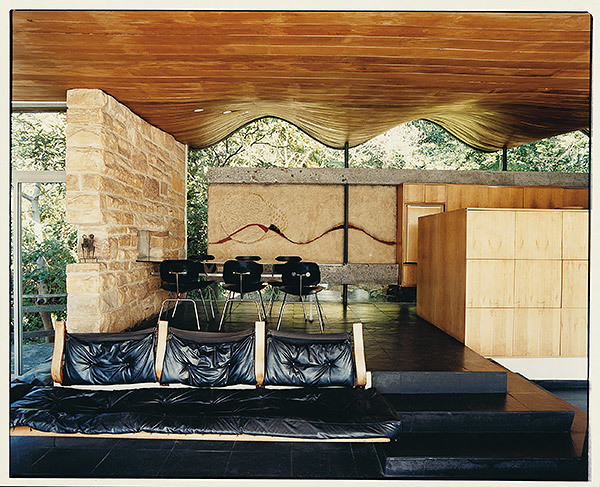
The Buhrich House II, architect Hugh Buhrich. Photograph © Michael Wee
Sydney Living Museums were quick to offer the Museum of Sydney, to lock in dates and to offer the skill of their staff to help navigate the process - much needed with a curatorial novice like me.
As an ex-magazine editor it was interesting to note the differences, as well as the commonalities, of communicating text and photographs in a exhibition instead of on the printed page. The scale took some getting used to as the panels are 1.5m square, and both Tracy Lines (who art directed the images in conjunction with Anne-Louise Falson at Sydney Living Museums) and I found we had to tape bits of newspaper together and lay it out on her floor to keep reminding us of the size. We also learnt a lot about how someone moves through an exhibition, how much they are prepared to read, where the eye line travels and how long they will spend with a video. This was all a steep learning curve.
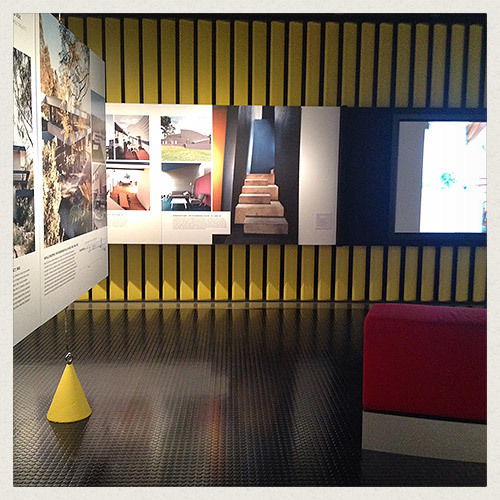
What did make sense was to move away from the chronological treatment of the houses in the book, which progress steadily through the decades. Instead the houses were pulled together in themes which worked across decades, across state borders and across stylistic approaches. Early pioneers, use of materials, the house as sculpture, relationship to landscape, the changing floorplan and living in an architecture designed house, form the structure of the exhibition and work remarkably well as a way of tell the story of Australian domestic architecture in the last 60 years.
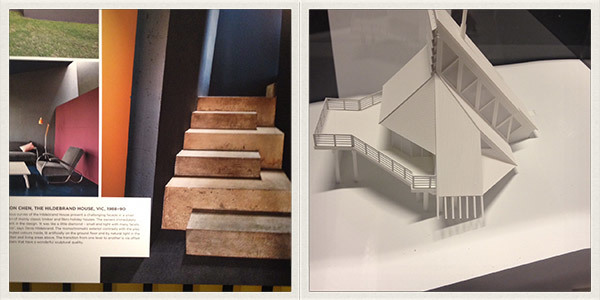
But we were keen it wasn't just an exhibition images, no matter how beautiful Michael Wee's shots are, and so we chose a number of house plans to create the most exquisite jewel-like models in white. They are exquisite, delicate objects, enclosed in Perspex.
And then there is the video. We started out with a view that it would be 20 minutes and then gathered so much wonderful content from architects and homeowners alongside visual house tours that it runs much longer than that. Each is a contained piece which makes it easy to dip in and out of the content depending on which architects, or home, appeals to you. The team, Rebecca and Mason, visited Melbourne and Canberra as well as Sydney (and we interviewed Brit Andresen from Queensland) to get a broad range of architectural opinions.
During the process of discussing how the exhibition should look, Ewan McEion, Lindsay's son, came up with the idea of a table with Iconic Houses books, iPads and a selection of plans.
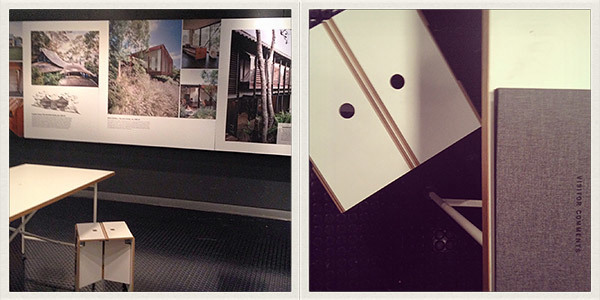
I loved the idea of having a small slice of domesticity in an exhibition space where people could sit and flick and spend time with the content. I was therefore delighted that (smow) were prepared to lend us six of their Kabre Falter stools and two white Egon Eiermann tables - add to this two of my favourite lights, the Gubi light from Cult, and you have the perfect setting: clean, modern, functional and beautiful. The generous spirit of others is always very touching.
The final flourish is a toe in the water into the world of augmented reality. New brand snaploader donated its remarkable technology which turns a two-dimensional plan into 3-D – giving a sense of volumes, space and window openings.
Also, pointing to the future we have a house from my forthcoming book, 'superhouse: architecture and interiors beyond the everyday', published by Penguin/Lantern. For this we have chosen John Wardle's Fairhaven House in Victoria, a tremendous example of what timber can do, when imaginatively treated. It also won the Robin Boyd Award for architecture – the highest accolade in the land for a residential building.
The exhibition is at the core of a number of talks and house tours including my own, which as you can imagine will entail a lot of tidying up. For all talk and tour details visit the Sydney Living Museums website.
Update: This promotion is now over. Congratulations to Vangie M!
Iconic Australian Houses Exhibition - Museum of Sydney
Karen McCartney gives an insight into the development of her Iconic Australian Houses exhibition, running at the Museum of Sydney until August 17.
Rose Seidler House, architect Harry Seidler. Photograph © Michael Wee.
It is a rare opportunity to be able to curate an exhibition and have the experience of working with the team at Sydney Living Museums to produce a show that is small but perfectly formed, on a subject close to your heart.
I am a great believer that in order to be the recipient of opportunity you need to put yourself in its way, and I feel fortunate that the work put into researching and writing two books '50/60/70 Iconic Australian Houses' and its sequel '70/80/90 iconic Australian Houses' has found another expression in this exhibition.
The Rosenburg/Hills House, architect Neville Gruzman. Photograph © Michael Wee
As chance would have it I met architect, and convenor of the Architecture Foundation of Australia, Lindsay Johnston because I sold him some of the aforesaid books for his students at the Glenn Murcutt Master Classes. I wrapped them in brown paper and left them at the Brooklyn Marina for him to pick up in his tinnie, from his home in the Hawkesbury River.
When we did get talking we discovered we both hailed from Northern Ireland and had a shared history. He had produced a very successful exhibition on the work of Glenn Murcutt which had launched at the Museum of Sydney and then travelled the world. What if, he proposed, we could do an exhibition around the content of the two books? Often these conversations go nowhere, but Lindsay's determination and architectural contacts saw it begin to take shape, step-by-step. One of the most wonderful things to happen was that Stormtech, a family owned business producing some of the world's most stylish architectural drainage systems, agreed to sponsor the exhibition. Without the generosity of commercial partners the best of ideas go nowhere, so this gave us a huge boost and the impetus to seek out other partners which included the NSW Architects Registration Board and the University of Newcastle.
The Buhrich House II, architect Hugh Buhrich. Photograph © Michael Wee
Sydney Living Museums were quick to offer the Museum of Sydney, to lock in dates and to offer the skill of their staff to help navigate the process - much needed with a curatorial novice like me.
As an ex-magazine editor it was interesting to note the differences, as well as the commonalities, of communicating text and photographs in a exhibition instead of on the printed page. The scale took some getting used to as the panels are 1.5m square, and both Tracy Lines (who art directed the images in conjunction with Anne-Louise Falson at Sydney Living Museums) and I found we had to tape bits of newspaper together and lay it out on her floor to keep reminding us of the size. We also learnt a lot about how someone moves through an exhibition, how much they are prepared to read, where the eye line travels and how long they will spend with a video. This was all a steep learning curve.
What did make sense was to move away from the chronological treatment of the houses in the book, which progress steadily through the decades. Instead the houses were pulled together in themes which worked across decades, across state borders and across stylistic approaches. Early pioneers, use of materials, the house as sculpture, relationship to landscape, the changing floorplan and living in an architecture designed house, form the structure of the exhibition and work remarkably well as a way of tell the story of Australian domestic architecture in the last 60 years.
But we were keen it wasn't just an exhibition images, no matter how beautiful Michael Wee's shots are, and so we chose a number of house plans to create the most exquisite jewel-like models in white. They are exquisite, delicate objects, enclosed in Perspex.
And then there is the video. We started out with a view that it would be 20 minutes and then gathered so much wonderful content from architects and homeowners alongside visual house tours that it runs much longer than that. Each is a contained piece which makes it easy to dip in and out of the content depending on which architects, or home, appeals to you. The team, Rebecca and Mason, visited Melbourne and Canberra as well as Sydney (and we interviewed Brit Andresen from Queensland) to get a broad range of architectural opinions.
During the process of discussing how the exhibition should look, Ewan McEion, Lindsay's son, came up with the idea of a table with Iconic Houses books, iPads and a selection of plans.
I loved the idea of having a small slice of domesticity in an exhibition space where people could sit and flick and spend time with the content. I was therefore delighted that (smow) were prepared to lend us six of their Kabre Falter stools and two white Egon Eiermann tables - add to this two of my favourite lights, the Gubi light from Cult, and you have the perfect setting: clean, modern, functional and beautiful. The generous spirit of others is always very touching.
The final flourish is a toe in the water into the world of augmented reality. New brand snaploader donated its remarkable technology which turns a two-dimensional plan into 3-D – giving a sense of volumes, space and window openings.
Also, pointing to the future we have a house from my forthcoming book, 'superhouse: architecture and interiors beyond the everyday', published by Penguin/Lantern. For this we have chosen John Wardle's Fairhaven House in Victoria, a tremendous example of what timber can do, when imaginatively treated. It also won the Robin Boyd Award for architecture – the highest accolade in the land for a residential building.
The exhibition is at the core of a number of talks and house tours including my own, which as you can imagine will entail a lot of tidying up. For all talk and tour details visit the Sydney Living Museums website.
Update: This promotion is now over. Congratulations to Vangie M!
Explore More








Head Office (No Showroom)
2/1-7 Unwins Bridge Rd, St Peters,
NSW 2044, Australia
Your customer reference #:
01-X-CSN