



Updated 7 April 2021
Artisan Magazine introduces Deb Taylor & Little White Dish
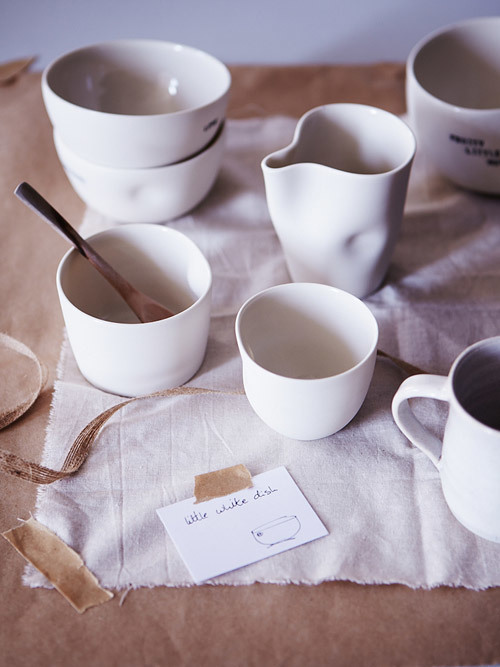
We recently introduced you to Natalie Hunfalvay, Leigh-Ann Thomas and Bhavani Konings and their quarterly iPad publication, Artisan Magazine. They profiled Melbourne textile studio Ink & Spindle and also gave us a sneak peek inside their latest issue. Today, they share 'Wonders of the Wheel', a fascinating profile (and video) of Sydney-based ceramicist Deb Taylor of Little White Dish. Deb has kindly donated a beautiful ceramic tumbler for one lucky T&W member. Leave a comment here for your chance to win - full details are below.
You can follow Artisan Magazine on Facebook, on Pinterest or on Instagram @artisanmagazine.
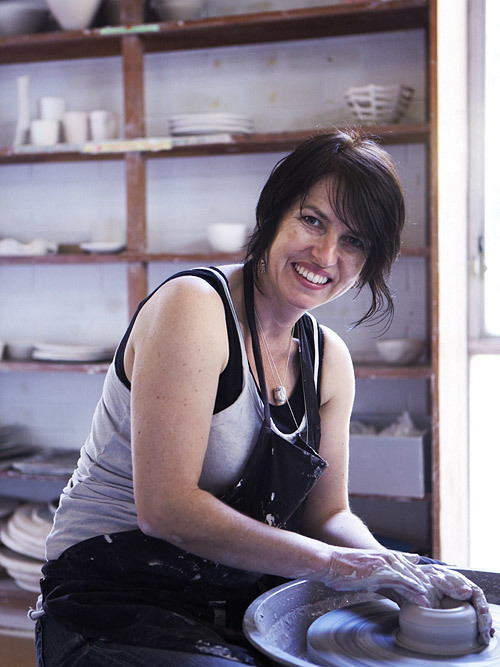
Deb Taylor is a ceramic artist like no other. Deb has been 'throwing' (which refers to the process of forming a vessel on the pottery wheel) for about 21 years and is truly a master of her craft. The Artisan team sat down with Deb to ask her a number of questions about her work and especially her process and relationship with ceramic art.
Deb describes her first encounter with the pottery wheel as an almost all-consuming process. As she so beautifully puts it, "I was totally captivated by the process of creating a vessel on the wheel from a ball or lump of clay using skill, control, grace, strength and sometimes the holding of breath until that precarious moment has passed and the shape is formed and it stays." Her relationship to clay continued to develop and Deb went on to take a number of classes and studied at the National Art School (previously East Sydney TAFE). As her knowledge evolved so did her passion for making functional ceramic pieces that have "simple, quiet shapes". Deb sells this ceramic range out of her store little white dish – a sweet name for simple and elegant pieces like cups, bowls, jugs and tealight holders…
Check out the video of Deb Taylor - Little White Dish Ceramics from Artisan Magazine on Vimeo.
Getting to see Deb in action was a special moment for us; her strength and grace at the wheel, working with the clay and wedging it, she made everything seem so simple. Of course, anything that looks this simple almost never is! Deb was kind enough to explain (and show us) the steps involved from the first touch of the clay in your hands to the last moment of forming a vessel and finishing it with glaze.
The Process
As we found out during our time with Deb, not only is sitting down to the wheel preceded by a whole thought process, but there is also a distinct language to the art of pottery. We asked Deb for a ceramics 101/introductory tutorial on the processes and here is what she shared with us:
Wedging
Wedging is done to align all the particles in the clay - a bit like slates on a roof as opposed to them lying in a haphazard way. Getting them aligned evens out any inconsistencies, gives strength to the vessel, removes air bubbles and prepares the clay for the next step. I teach my students the more difficult spiral wedge. It takes longer to learn, but I believe it prepares the clay better and it's far lovelier to look at.
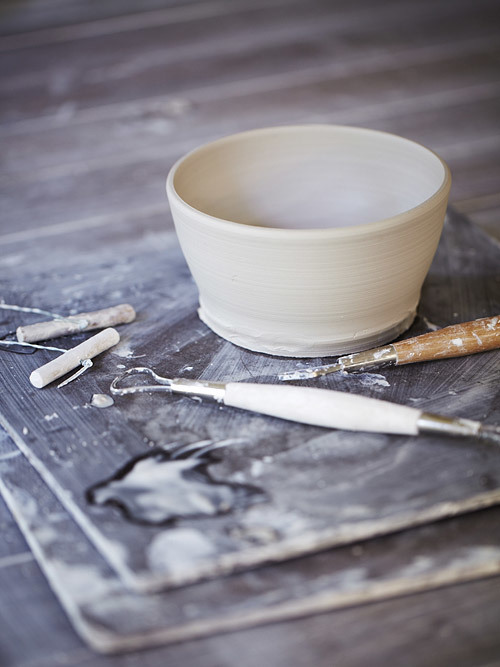
Cutting
When you cut up the clay after wedging you need to know what you're making so you have a large enough ball of clay. This is obviously an important decision because you need enough clay for the final product.
Centring
Centring involves throwing the clay really firmly down in the middle of the wheel so it attaches well. If not done properly, the clay may fly off as the wheel at this stage should be going really fast. Plenty of water is needed for lubrication and one should get up close to the wheel and engage those stomach muscles! As soon as the clay is centred and there's no play (movement) in your hands, you can cone the clay up and bring down three times.
These steps continue the process of aligning the clay particles, removing bubbles and strengthening the clay. When you've brought down the clay after the third cone you need to decide how wide the base of the vessel is going to be. If the clay is 'perfectly' centred it's time to proceed and open up the top.
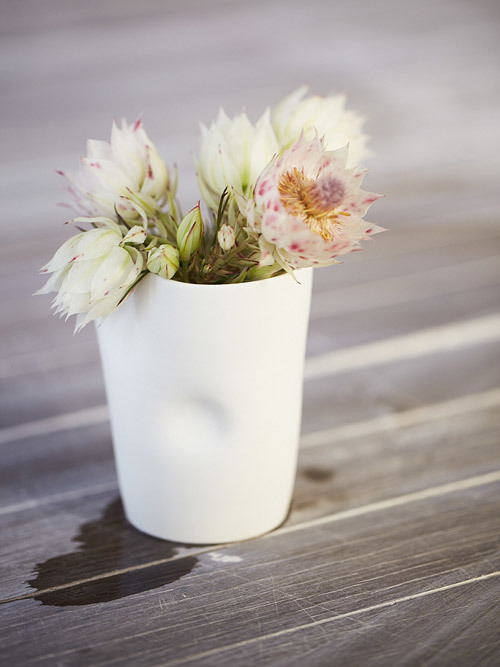
Of course, not every student/learner will be able to do this perfectly or consistently, and Deb describes some of the problems folks can encounter at the wheel.
If the clay is not centred before you start it's never going to be even - one side will be thicker than the other, which will cause inconsistent wall thickness throughout and a vessel with a high side and a low side. This may not be a problem, but when you want to turn it upside down to tidy up the base (turn the foot), the vessel won't sit evenly on the wheel.
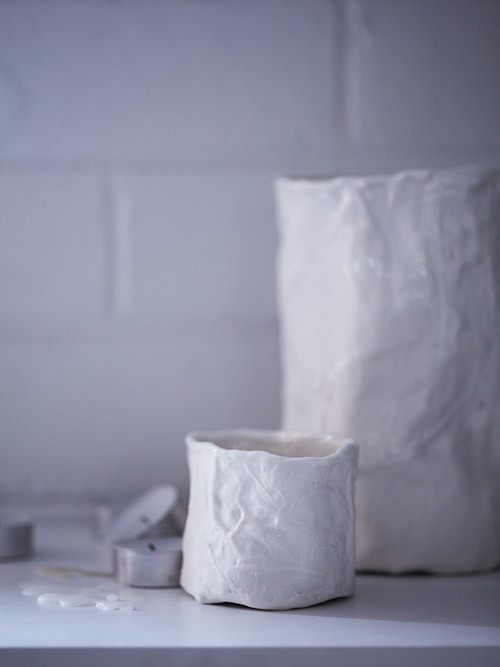
She encourages students and highlights the significance of resolving issues before moving onto each next step; indeed, some issues will continue to come back if not taken care of in the previous processes. She says that clay has a memory of its traumas and mistakes can reform their warped shape during the firing process. One of the ways to tackle centring issues is to focus on anchoring elbows and keep hands/fingers connected when throwing and turning, allowing overall better control of the processes. Of course, there are many other issues where things can go 'wrong' – like in any artistic or creative process. Deb suggests that it's good to strive for a piece with even thickness throughout so the finished product has a lovely balance and is a pleasure to hold.
Deb's ceramic pieces are wonderful illustrations of her creative mind. She sells her little white dish range and other pieces through her website and other pieces at various stockists. You can also follow Deb on Instagram @littlewhitedish
Love this story? You can follow Artisan Magazine on Facebook, on Pinterest or on Instagram @artisanmagazine.
Artisan Magazine's final issue was published in May 2016.
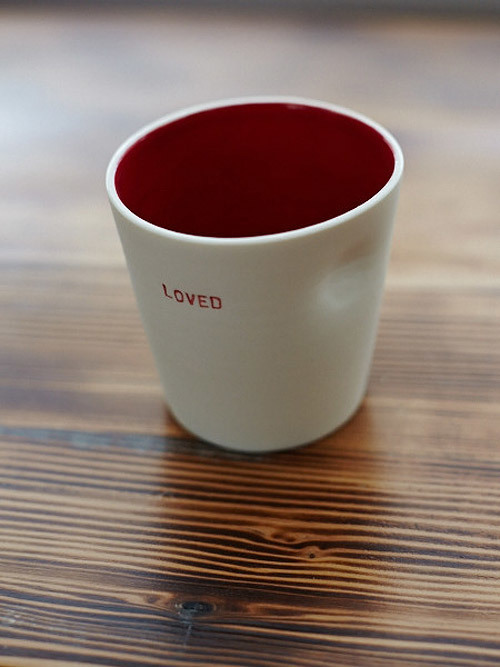
To win this beautiful ceramic tumbler, made by Deb Taylor of Little White Dish, leave a comment here on the blog before 5pm (AEST) on Monday 20 January 2014. You must be a member of Temple & Webster to enter, and you may only enter once. We will choose our favourite comment, and will notify the winner via their Facebook page or at the email address attached to their Temple & Webster account (if we are able to ascertain it) by Tuesday 28 January 2013. If we are unable to make contact with the winner via either of those methods within 30 days, we'll choose a replacement winner. Good luck!
Competition closed.
We recently introduced you to Natalie Hunfalvay, Leigh-Ann Thomas and Bhavani Konings and their quarterly iPad publication, Artisan Magazine. They profiled Melbourne textile studio Ink & Spindle and also gave us a sneak peek inside their latest issue. Today, they share 'Wonders of the Wheel', a fascinating profile (and video) of Sydney-based ceramicist Deb Taylor of Little White Dish. Deb has kindly donated a beautiful ceramic tumbler for one lucky T&W member. Leave a comment here for your chance to win - full details are below.
You can follow Artisan Magazine on Facebook, on Pinterest or on Instagram @artisanmagazine.
Deb Taylor is a ceramic artist like no other. Deb has been 'throwing' (which refers to the process of forming a vessel on the pottery wheel) for about 21 years and is truly a master of her craft. The Artisan team sat down with Deb to ask her a number of questions about her work and especially her process and relationship with ceramic art.
Deb describes her first encounter with the pottery wheel as an almost all-consuming process. As she so beautifully puts it, "I was totally captivated by the process of creating a vessel on the wheel from a ball or lump of clay using skill, control, grace, strength and sometimes the holding of breath until that precarious moment has passed and the shape is formed and it stays." Her relationship to clay continued to develop and Deb went on to take a number of classes and studied at the National Art School (previously East Sydney TAFE). As her knowledge evolved so did her passion for making functional ceramic pieces that have "simple, quiet shapes". Deb sells this ceramic range out of her store little white dish – a sweet name for simple and elegant pieces like cups, bowls, jugs and tealight holders…
Check out the video of Deb Taylor - Little White Dish Ceramics from Artisan Magazine on Vimeo.
Getting to see Deb in action was a special moment for us; her strength and grace at the wheel, working with the clay and wedging it, she made everything seem so simple. Of course, anything that looks this simple almost never is! Deb was kind enough to explain (and show us) the steps involved from the first touch of the clay in your hands to the last moment of forming a vessel and finishing it with glaze.
The Process
As we found out during our time with Deb, not only is sitting down to the wheel preceded by a whole thought process, but there is also a distinct language to the art of pottery. We asked Deb for a ceramics 101/introductory tutorial on the processes and here is what she shared with us:
Wedging
Wedging is done to align all the particles in the clay - a bit like slates on a roof as opposed to them lying in a haphazard way. Getting them aligned evens out any inconsistencies, gives strength to the vessel, removes air bubbles and prepares the clay for the next step. I teach my students the more difficult spiral wedge. It takes longer to learn, but I believe it prepares the clay better and it's far lovelier to look at.
Cutting
When you cut up the clay after wedging you need to know what you're making so you have a large enough ball of clay. This is obviously an important decision because you need enough clay for the final product.
Centring
Centring involves throwing the clay really firmly down in the middle of the wheel so it attaches well. If not done properly, the clay may fly off as the wheel at this stage should be going really fast. Plenty of water is needed for lubrication and one should get up close to the wheel and engage those stomach muscles! As soon as the clay is centred and there's no play (movement) in your hands, you can cone the clay up and bring down three times.
These steps continue the process of aligning the clay particles, removing bubbles and strengthening the clay. When you've brought down the clay after the third cone you need to decide how wide the base of the vessel is going to be. If the clay is 'perfectly' centred it's time to proceed and open up the top.
Of course, not every student/learner will be able to do this perfectly or consistently, and Deb describes some of the problems folks can encounter at the wheel.
If the clay is not centred before you start it's never going to be even - one side will be thicker than the other, which will cause inconsistent wall thickness throughout and a vessel with a high side and a low side. This may not be a problem, but when you want to turn it upside down to tidy up the base (turn the foot), the vessel won't sit evenly on the wheel.
She encourages students and highlights the significance of resolving issues before moving onto each next step; indeed, some issues will continue to come back if not taken care of in the previous processes. She says that clay has a memory of its traumas and mistakes can reform their warped shape during the firing process. One of the ways to tackle centring issues is to focus on anchoring elbows and keep hands/fingers connected when throwing and turning, allowing overall better control of the processes. Of course, there are many other issues where things can go 'wrong' – like in any artistic or creative process. Deb suggests that it's good to strive for a piece with even thickness throughout so the finished product has a lovely balance and is a pleasure to hold.
Deb's ceramic pieces are wonderful illustrations of her creative mind. She sells her little white dish range and other pieces through her website and other pieces at various stockists. You can also follow Deb on Instagram @littlewhitedish
Love this story? You can follow Artisan Magazine on Facebook, on Pinterest or on Instagram @artisanmagazine.
Artisan Magazine's final issue was published in May 2016.
To win this beautiful ceramic tumbler, made by Deb Taylor of Little White Dish, leave a comment here on the blog before 5pm (AEST) on Monday 20 January 2014. You must be a member of Temple & Webster to enter, and you may only enter once. We will choose our favourite comment, and will notify the winner via their Facebook page or at the email address attached to their Temple & Webster account (if we are able to ascertain it) by Tuesday 28 January 2013. If we are unable to make contact with the winner via either of those methods within 30 days, we'll choose a replacement winner. Good luck!
Competition closed.
Explore More








Head Office (No Showroom)
2/1-7 Unwins Bridge Rd, St Peters,
NSW 2044, Australia
Your customer reference #:
01-X-CSN