



Updated 25 March 2021
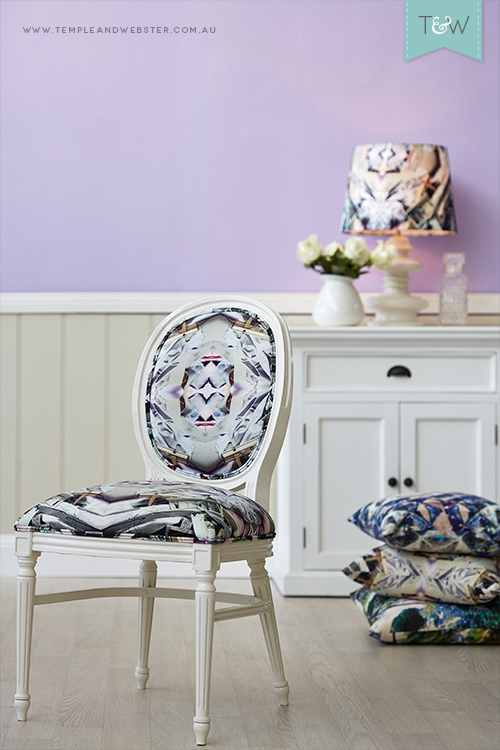
Karen McCartney interviews Sharyn Storrier Lyneham, founder and owner of EDIT, whose innovative fabrics are featured covering chairs, lamp shades and soft furnishings.
There are few people in Australia with the pedigree of Sharyn Storrier Lyneham when it comes to creating visual worlds we aspire to. Whether it is that of food and dining through the pages of Vogue Entertaining + Travel, or homes with a quirky elegance in Vogue Living, she made her mark on how we want to live, to eat and, moreover, how we want our homes to look. When it comes to an Australian 'lifestyle' that is the envy of the world, she wrote the book. Karen McCartney talks to Sharyn about her life in media and her sense of coming full circle back to her first loves of art and fabric, through her business EDIT.
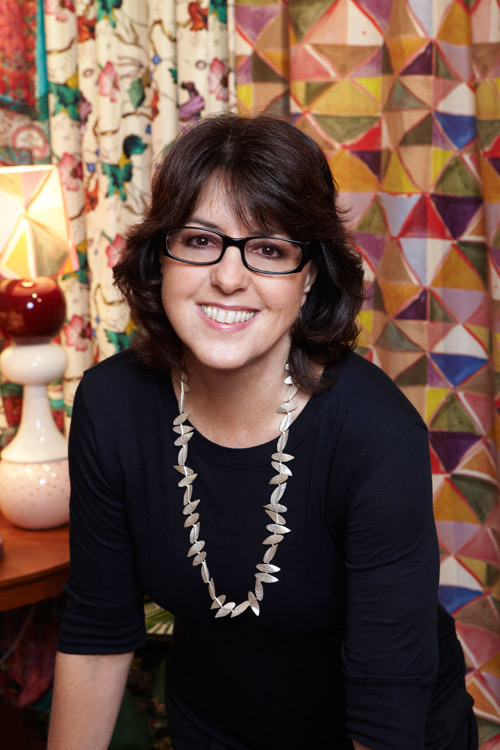
You were always creative and studied art. Did you ever imagine the path that it would take you on?
No absolutely not – like many young people I didn't know what I wanted to do and art college was a pretty radical choice back then. But I was good at it and it was fun. After college I took up fine art and then married artist Tim Storrier but there is only room for one artist in a family and he was clearly so very talented.
Was travel part of your expanding world view?
Like many young Australians I took the boat to Europe intending to stay for 6 months and ended up staying for many years. I worked in London, at Liberty, where one of my favourite jobs was hand-painting plates to match a fabric table cloth as a bespoke table setting for a client. I ended up designing books at Paul Hamlyn and Collins publishers where I worked on children's books. It was a most enjoyable time.
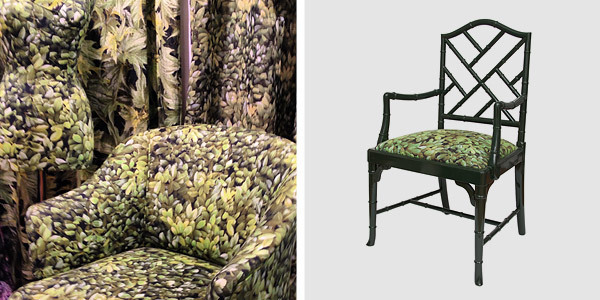
The Glossy Leaves print on a tub chair and carver
What was it like to return to Sydney?
A friend was working at Vogue and got me a job freelancing on special editions, but I still didn't see this as a career. Then one day the art director at Vogue Living upped and left and I was offered the job. I then worked as creative director of Vogue during the 1980s when I got the chance to work with those really great international fashion photographers. It was an exciting time for magazines.
You made the transition from art director to the editor position of Vogue Entertaining + Travel. Was that an unusual career move?
You are right, this jump had never happened before. I knew they were having trouble finding an editor and when Editor-in-Chief June McCallum approached me I didn't know what to do. June was fantastic and said, 'I am going to give it to you anyway – with strong support around you.
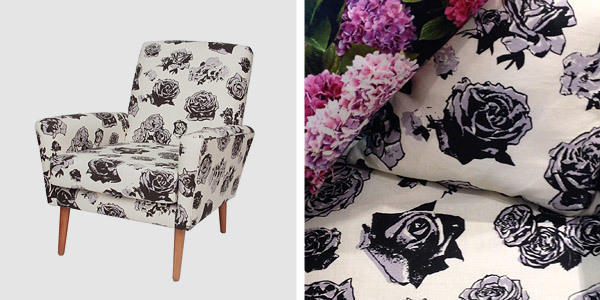
The Black Roses armchair
What was your creative vision and how did you bring about change?
I wasn't a trained journalist so I took the pragmatic view that if I could draw people in visually and then support the visuals with great writing, it would work. I used new photographers, shot with natural light and avoided the tortured, harshly lit and inedible result that had become the norm in food photography. My brief was: 'I want us to be able to sit down and eat it when we finish photography.' I really wanted to bring it back to basics. I was born in the country where food is very nurturing. As a child I had eaten off the land, and my grandmother had cooked brilliantly for the shearers. I wanted stories of innovative home cooks, the chefs, the provedores. I wanted people to understand that they lived in the land of plenty. So while it was a simple formula, it was also globally pioneering.
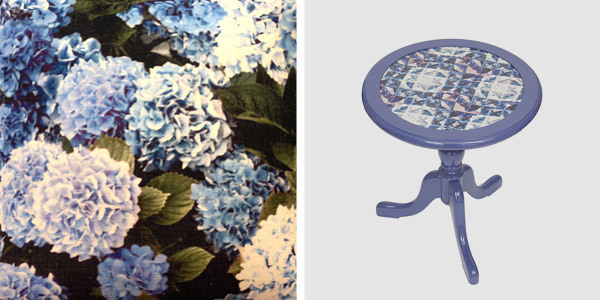
A beautiful hydrangea design and the Crystals decoupage table
Were you given a completely free rein?
I did have a lot of freedom but I also worked hard; I was a very hands-on editor. Some of the shoots I did with photographer Geoff Lung started at 7am and went to 3am. I was stylist, box packer, removalist – all rolled into one! Creatively, I played with the covers and we did very different, daring things. I was told more than once that my head was on the block if the issue didn't sell – especially around images such as an empty dessert plate with smeared chocolate cake. Visuals like that are quite commonplace today but were considered radical then.
You then moved into the role of Editor-in-Chief of both Vogue Living and Vogue Entertaining + Travel. What do you think you learnt most from your years on the Vogue brands?
I loved my career very much. There is such an art to the patchwork of building a magazine with the best content – constantly manipulating images, pages and stories to make it work. I learnt to get good people around you, let them do their job and also to let them grow.
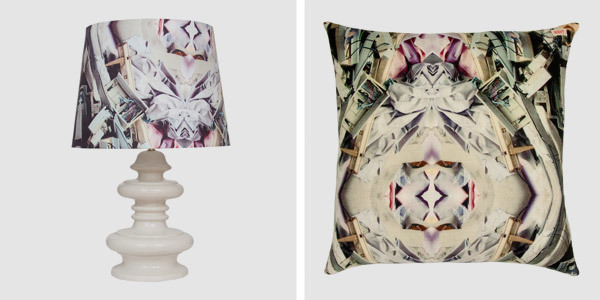
The 'Rubbish' Table Lamp and Cushion, inspired by a photograph taken in Paris
Did the idea for EDIT come to you quickly after your career shift ?
I have always loved fabrics but originally my idea was for an emporium of fascinating things made up of my fabrics alongside refurbished furniture and the work of young designers, artists and sculptors. We did special eye-catching pieces for the media to launch the brand. Perhaps it was too fanciful. After a period of time it became clear that I should focus on the design and digital printing of my own fabrics. Of course there were all sorts of teething problems and there were years of experimentation and development to get exactly what I wanted. But I am passionate about it and I was one of the few people in the world doing it on upholstery fabric when I started.
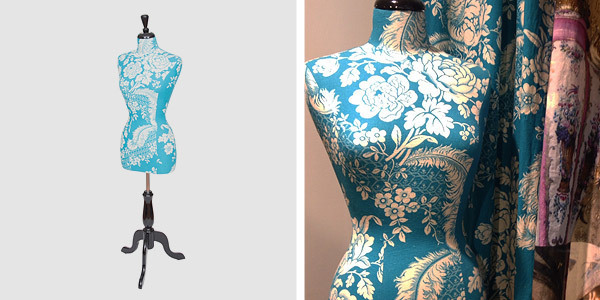
The Plume mannequin
You have an original approach that is distinctively yours rather than a trend driven one. What inspires your choices?
I love that we can capture everything with digital printing – all the colour nuances are there in the final product. For example this print, taken from a photograph I took in the Borghese Gardens in Rome, has these pink highlights on the trees and I love the fact it has been retained and not over sanitised. I want the imperfections to be part of the character of the piece. Inspiration can come from anywhere - this print of rubbish comes from a photograph I took in Paris. I work with a brilliant girl who understands how to create the repeating print in the most beautiful way. We end up with truly original product.
What was your vision for the business?
The mantra when we started was 'Decoration without explanation'. I wanted to break the rules about what you can do with interiors fabric. I want people to smile when they come into a room, to be happy; the same goes for when they come into the showroom.
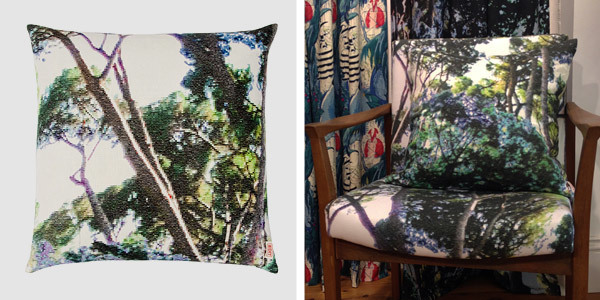
The 'Trees' cushion and occasional chair
Is keeping printing and manufacturing local important to you?
Very important. The first thing I say when people come into the shop is that we design and print locally. This is important for all the right, good reasons, but also for reasons of quality control. I am working with international hotel groups, such as Firmdale Hotels, but I wanted it to come from here, to come from Australia.
Your pieces have a great energy through colour and pattern. Do you have any advice for how people should use these pieces in their home?
It is quite simple – all they have to do is love it. In the same way you love a dress or a painting; if you love a piece it will work. Eclectic interiors are fun. Stop worrying about everything having to 'go'. With a bit of confidence you create your own personal decorating story – a bold accent will make a neutral room sing, add an element of soul, and most importantly make it yours.
And remember this is advice from one who knows. Really knows.
If you love the look, find out more about EDIT at their website.
Sharyn Storrier Lyneham - EDIT
Karen McCartney interviews Sharyn Storrier Lyneham, founder and owner of EDIT, whose innovative fabrics are featured covering chairs, lamp shades and soft furnishings.
There are few people in Australia with the pedigree of Sharyn Storrier Lyneham when it comes to creating visual worlds we aspire to. Whether it is that of food and dining through the pages of Vogue Entertaining + Travel, or homes with a quirky elegance in Vogue Living, she made her mark on how we want to live, to eat and, moreover, how we want our homes to look. When it comes to an Australian 'lifestyle' that is the envy of the world, she wrote the book. Karen McCartney talks to Sharyn about her life in media and her sense of coming full circle back to her first loves of art and fabric, through her business EDIT.
You were always creative and studied art. Did you ever imagine the path that it would take you on?
No absolutely not – like many young people I didn't know what I wanted to do and art college was a pretty radical choice back then. But I was good at it and it was fun. After college I took up fine art and then married artist Tim Storrier but there is only room for one artist in a family and he was clearly so very talented.
Was travel part of your expanding world view?
Like many young Australians I took the boat to Europe intending to stay for 6 months and ended up staying for many years. I worked in London, at Liberty, where one of my favourite jobs was hand-painting plates to match a fabric table cloth as a bespoke table setting for a client. I ended up designing books at Paul Hamlyn and Collins publishers where I worked on children's books. It was a most enjoyable time.
The Glossy Leaves print on a tub chair and carver
What was it like to return to Sydney?
A friend was working at Vogue and got me a job freelancing on special editions, but I still didn't see this as a career. Then one day the art director at Vogue Living upped and left and I was offered the job. I then worked as creative director of Vogue during the 1980s when I got the chance to work with those really great international fashion photographers. It was an exciting time for magazines.
You made the transition from art director to the editor position of Vogue Entertaining + Travel. Was that an unusual career move?
You are right, this jump had never happened before. I knew they were having trouble finding an editor and when Editor-in-Chief June McCallum approached me I didn't know what to do. June was fantastic and said, 'I am going to give it to you anyway – with strong support around you.
The Black Roses armchair
What was your creative vision and how did you bring about change?
I wasn't a trained journalist so I took the pragmatic view that if I could draw people in visually and then support the visuals with great writing, it would work. I used new photographers, shot with natural light and avoided the tortured, harshly lit and inedible result that had become the norm in food photography. My brief was: 'I want us to be able to sit down and eat it when we finish photography.' I really wanted to bring it back to basics. I was born in the country where food is very nurturing. As a child I had eaten off the land, and my grandmother had cooked brilliantly for the shearers. I wanted stories of innovative home cooks, the chefs, the provedores. I wanted people to understand that they lived in the land of plenty. So while it was a simple formula, it was also globally pioneering.
A beautiful hydrangea design and the Crystals decoupage table
Were you given a completely free rein?
I did have a lot of freedom but I also worked hard; I was a very hands-on editor. Some of the shoots I did with photographer Geoff Lung started at 7am and went to 3am. I was stylist, box packer, removalist – all rolled into one! Creatively, I played with the covers and we did very different, daring things. I was told more than once that my head was on the block if the issue didn't sell – especially around images such as an empty dessert plate with smeared chocolate cake. Visuals like that are quite commonplace today but were considered radical then.
You then moved into the role of Editor-in-Chief of both Vogue Living and Vogue Entertaining + Travel. What do you think you learnt most from your years on the Vogue brands?
I loved my career very much. There is such an art to the patchwork of building a magazine with the best content – constantly manipulating images, pages and stories to make it work. I learnt to get good people around you, let them do their job and also to let them grow.
The 'Rubbish' Table Lamp and Cushion, inspired by a photograph taken in Paris
Did the idea for EDIT come to you quickly after your career shift ?
I have always loved fabrics but originally my idea was for an emporium of fascinating things made up of my fabrics alongside refurbished furniture and the work of young designers, artists and sculptors. We did special eye-catching pieces for the media to launch the brand. Perhaps it was too fanciful. After a period of time it became clear that I should focus on the design and digital printing of my own fabrics. Of course there were all sorts of teething problems and there were years of experimentation and development to get exactly what I wanted. But I am passionate about it and I was one of the few people in the world doing it on upholstery fabric when I started.
The Plume mannequin
You have an original approach that is distinctively yours rather than a trend driven one. What inspires your choices?
I love that we can capture everything with digital printing – all the colour nuances are there in the final product. For example this print, taken from a photograph I took in the Borghese Gardens in Rome, has these pink highlights on the trees and I love the fact it has been retained and not over sanitised. I want the imperfections to be part of the character of the piece. Inspiration can come from anywhere - this print of rubbish comes from a photograph I took in Paris. I work with a brilliant girl who understands how to create the repeating print in the most beautiful way. We end up with truly original product.
What was your vision for the business?
The mantra when we started was 'Decoration without explanation'. I wanted to break the rules about what you can do with interiors fabric. I want people to smile when they come into a room, to be happy; the same goes for when they come into the showroom.
The 'Trees' cushion and occasional chair
Is keeping printing and manufacturing local important to you?
Very important. The first thing I say when people come into the shop is that we design and print locally. This is important for all the right, good reasons, but also for reasons of quality control. I am working with international hotel groups, such as Firmdale Hotels, but I wanted it to come from here, to come from Australia.
Your pieces have a great energy through colour and pattern. Do you have any advice for how people should use these pieces in their home?
It is quite simple – all they have to do is love it. In the same way you love a dress or a painting; if you love a piece it will work. Eclectic interiors are fun. Stop worrying about everything having to 'go'. With a bit of confidence you create your own personal decorating story – a bold accent will make a neutral room sing, add an element of soul, and most importantly make it yours.
And remember this is advice from one who knows. Really knows.
If you love the look, find out more about EDIT at their website.
Explore More








Head Office (No Showroom)
2/1-7 Unwins Bridge Rd, St Peters,
NSW 2044, Australia
Your customer reference #:
01-X-CSN