



Updated 8 April 2021
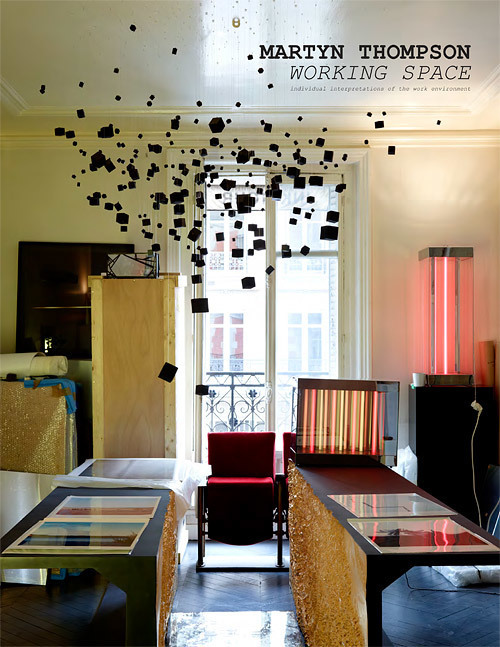
Karen McCartney caught up with New York-based photographer Martyn Thompson to learn about his new book 'Working Space', published by Hardie Grant.
The common thread in this book is that all the spaces, while about work, feel clearly integrated into the life of the person. Do you think you have tapped into a trend of merging life/work spaces?
I think 'work ' is a hot topic. The advance of the Internet has mobilised the work landscape and in most countries the idea of a job and job security isn't what it was 30 years ago. What I'm looking at in 'Working Space' is ways of expressing yourself and the possibility of being creative in any environment.
You told me that you didn't rearrange the spaces but simply captured what was there. Is this something new for you and does it define the book's aesthetic?
It's not new to me but it is different from how a magazine editorial often approaches an interior. I think I've achieved something honest. It's immediate and very much about the spirit and focus of a place rather than a floor to ceiling description. I haven't rearranged the furniture or filled the room with flowers that weren't there previously. It's not a book about how to decorate but rather a series of stories to inspire the artist lurking within us all.
There is rawness and untrammeled creativity on every page yet the book showcases a great range of pursuits. How did you choose your subjects?
I asked almost everyone I know for suggestions. Some of the subjects are old friends and other people I only met briefly. I wanted as broad a range as possible and spaces that felt idiosyncratic but not too rarified.
The book has been sensitively and beautifully designed by Andrew Egan. How did he approach the design treatment?
Andrew is a minimalist - he lets the pictures speak. I love the typeface he uses - it has a 'functionality' that's so appropriate. We've worked together successfully for more than 20 years so there is a lot of trust and not much ego in the process - pretty smooth sailing…
Do you feel the world of interiors photography misrepresents 'life' and does your book redress the balance in some way?
I think people choose to live all sorts of ways and what's in 'Working Space' are places that, although quite varied, really speak to me.
The words have a lovely, personal feel either connected to, or commenting on, the space. Did you enjoy writing the text?
YES - writing is something quite new to me and I totally love it. I've worked as a visual artist for 30 years and it's very exciting to develop a new resource.
Quick fire questions
My personal workspace is defined by: many piles of things I'm working on as I like to have everything in easy visual reach
In a fire I would take: everything I could lay my hands on
My best work day always includes: some exercise, like a trip to the pool to clear my head
Want more? Order your copy of Working Space via Booktopia.
Martyn Thompson's 'Working Space'
Karen McCartney caught up with New York-based photographer Martyn Thompson to learn about his new book 'Working Space', published by Hardie Grant.
The common thread in this book is that all the spaces, while about work, feel clearly integrated into the life of the person. Do you think you have tapped into a trend of merging life/work spaces?
I think 'work ' is a hot topic. The advance of the Internet has mobilised the work landscape and in most countries the idea of a job and job security isn't what it was 30 years ago. What I'm looking at in 'Working Space' is ways of expressing yourself and the possibility of being creative in any environment.
You told me that you didn't rearrange the spaces but simply captured what was there. Is this something new for you and does it define the book's aesthetic?
It's not new to me but it is different from how a magazine editorial often approaches an interior. I think I've achieved something honest. It's immediate and very much about the spirit and focus of a place rather than a floor to ceiling description. I haven't rearranged the furniture or filled the room with flowers that weren't there previously. It's not a book about how to decorate but rather a series of stories to inspire the artist lurking within us all.
There is rawness and untrammeled creativity on every page yet the book showcases a great range of pursuits. How did you choose your subjects?
I asked almost everyone I know for suggestions. Some of the subjects are old friends and other people I only met briefly. I wanted as broad a range as possible and spaces that felt idiosyncratic but not too rarified.
The book has been sensitively and beautifully designed by Andrew Egan. How did he approach the design treatment?
Andrew is a minimalist - he lets the pictures speak. I love the typeface he uses - it has a 'functionality' that's so appropriate. We've worked together successfully for more than 20 years so there is a lot of trust and not much ego in the process - pretty smooth sailing…
Do you feel the world of interiors photography misrepresents 'life' and does your book redress the balance in some way?
I think people choose to live all sorts of ways and what's in 'Working Space' are places that, although quite varied, really speak to me.
The words have a lovely, personal feel either connected to, or commenting on, the space. Did you enjoy writing the text?
YES - writing is something quite new to me and I totally love it. I've worked as a visual artist for 30 years and it's very exciting to develop a new resource.
Quick fire questions
My personal workspace is defined by: many piles of things I'm working on as I like to have everything in easy visual reach
In a fire I would take: everything I could lay my hands on
My best work day always includes: some exercise, like a trip to the pool to clear my head
Want more? Order your copy of Working Space via Booktopia.
Explore More








Head Office (No Showroom)
2/1-7 Unwins Bridge Rd, St Peters,
NSW 2044, Australia
Your customer reference #:
01-X-CSN