



Updated 8 January 2021
Karen McCartney visits Adelaide's JamFactory, and writes about why design has never been more relevant.
Over the years I have judged many competitions for young Australian product designers and, for the most part, their efforts and ingenuity, are remarkable.
It is not an easy career path as, unlike in Europe there is little wide-spread government and industry support, and ‘making it’ on the international design stage is the equivalent of breaking into Hollywood. Marc Newson, whose Lockheed lounge sold for a staggering $4.69 million in a London auction recently, is one of the few global stars hailing from Australia.
At the other swing of the pendulum, young designers are learning the ropes of designing product through the process of developing concepts, prototyping, and manufacturing pieces which have both a useful purpose and design integrity. By which I mean original pieces that do not simply mimic existing designs.
The late, great American designer Charles Eames, who democratised design with the introduction of his iconic moulded fibreglass chairs, which still grace many a home and café today, was direct about the role of design. “The real questions are: does it solve a problem? Is it serviceable? How is it going to look in 10 years?" By resolving these questions and responding to the context and demands of a changing world, designers have never been more relevant.
I visited the JamFactory in Adelaide, a fantastic set up which supports skilled designers and craftspeople across furniture design, glass blowing, ceramics and metal work. Not only is there mentoring and facilities but a retail space which sells the work giving that ever important exposure to commerce.
I caught up with furniture designer Liam Mugavin, who had been a finalist in last year’s Temple & Webster Emerging Designer Award. He had sold a few items which had to be packaged and delivered across the country and it caused him to think about freight, and about how his designs could-flat pack for economy of distribution. I loved that he had responded to the experience and had evolved his concept and his designs to take account of the entire design journey.
How does the theory go? “It is not the strongest of the species that survive, nor the most intelligent, but the one most responsive to change.” Not, Liam, that I am suggesting you are lacking anything in the intelligence department!
Karen McCartney on why design matters
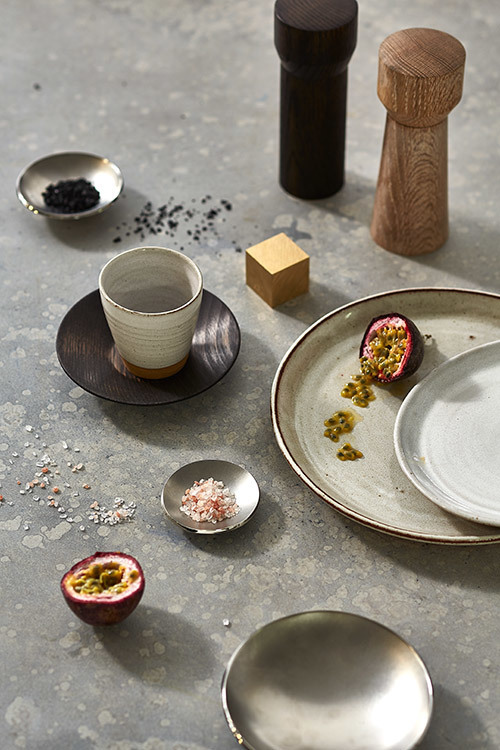 Photography - Denise Braki. Styling - Jono Fleming.
Karen McCartney visits Adelaide's JamFactory, and writes about why design has never been more relevant.
Over the years I have judged many competitions for young Australian product designers and, for the most part, their efforts and ingenuity, are remarkable.
It is not an easy career path as, unlike in Europe there is little wide-spread government and industry support, and ‘making it’ on the international design stage is the equivalent of breaking into Hollywood. Marc Newson, whose Lockheed lounge sold for a staggering $4.69 million in a London auction recently, is one of the few global stars hailing from Australia.
At the other swing of the pendulum, young designers are learning the ropes of designing product through the process of developing concepts, prototyping, and manufacturing pieces which have both a useful purpose and design integrity. By which I mean original pieces that do not simply mimic existing designs.
The late, great American designer Charles Eames, who democratised design with the introduction of his iconic moulded fibreglass chairs, which still grace many a home and café today, was direct about the role of design. “The real questions are: does it solve a problem? Is it serviceable? How is it going to look in 10 years?" By resolving these questions and responding to the context and demands of a changing world, designers have never been more relevant.
I visited the JamFactory in Adelaide, a fantastic set up which supports skilled designers and craftspeople across furniture design, glass blowing, ceramics and metal work. Not only is there mentoring and facilities but a retail space which sells the work giving that ever important exposure to commerce.
I caught up with furniture designer Liam Mugavin, who had been a finalist in last year’s Temple & Webster Emerging Designer Award. He had sold a few items which had to be packaged and delivered across the country and it caused him to think about freight, and about how his designs could-flat pack for economy of distribution. I loved that he had responded to the experience and had evolved his concept and his designs to take account of the entire design journey.
How does the theory go? “It is not the strongest of the species that survive, nor the most intelligent, but the one most responsive to change.” Not, Liam, that I am suggesting you are lacking anything in the intelligence department!
Explore More








Head Office (No Showroom)
2/1-7 Unwins Bridge Rd, St Peters,
NSW 2044, Australia
Your customer reference #:
01-X-CSN