


Blog

Updated 8 April 2021
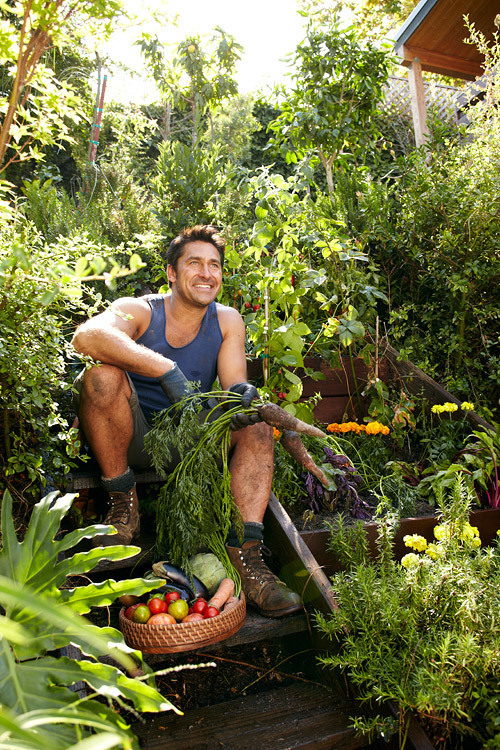
Karen McCartney talks to Jamie Durie about his career, his passions and why every home needs a vertical garden.
Jamie Durie is a man of many, diverse talents. His name is synonymous, through his successful TV shows here and in the USA, with rethinking outdoor spaces. He has written ten best-selling books including his latest, Edible Garden Design, and collaborates with a number of partners producing outdoor and indoor furniture and rugs, not to mention an organic skincare range and his own vertical garden system. I did say diverse.
Jamie and I first met 13 years ago when Inside Out magazine was launching and he had a small but thriving garden design business, PATIO, in North Sydney. We ran a feature on one of his schemes in an early issue of the magazine and witnessed his phenomenal growth from young garden designer to mega-brand.
You have had an amazing career trajectory. When we first met you were promoting your garden design business and now you have an enormous diversity of projects and product designs …what happened?
I guess I have a lot of drive and energy. Growing up was not without its hardships and I think that drive pushed me to achieve. My choices are always things I am passionate about – money isn't the primary driver. My father always said to follow your passion and the pension will follow. That is not to say I haven't made mistakes – I am a creative person rather than a businessman. That said, I have been lucky with some of the collaborations that have come my way.
Furniture, both indoor and out, now forms a major part of your business with the most recent launch a collaboration with Italian company Riva 1920, which showed for the first time at the Milan Furniture Fair in April (2013) how did that come about?
It is an interesting story. Every morning at 5am Anna Riva (co-owner) does the family ironing and watched my TV show. She sent me an email and pack of catalogues of the Riva 1920 products. We were excited by what we saw and wrote back immediately to show her the furniture we were doing. She then asked me to come and stay at their farm, outside Milan, and work with them on a collection. It was a fantastic experience and they have become like family to me.
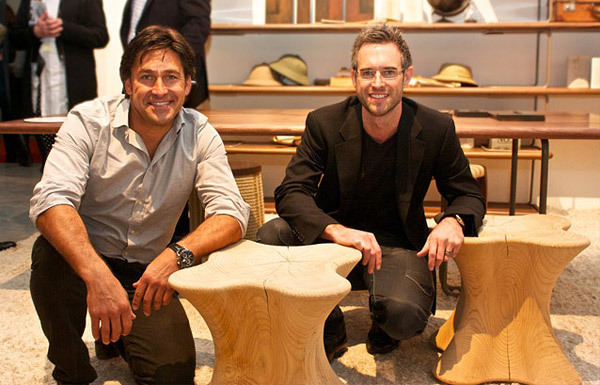
Jamie and David Knott from his design team at the Milan Furniture Fair with Jamie's Ficus Stool for Riva 1920. Image via Jamie's Pinterest board.
What was it like to launch a collection at the Milan Furniture Fair with all those serious design players?
Milan was so exciting – I was beside myself. We showed 9 pieces and are in the process of designing 16 more including chests of drawers and beds. Riva 1920 are able to source amazing materials; brass, pressed-leather, rose-tinted glass and even sea-weathered timbers dredged from Venetian canals.
The furniture has a feeling of timeless elegance – what aesthetic sensibility did you draw on to design them?
In 2006 I moved to LA and immersed myself in mid-century Modern design. I fell in love with the architecture of John Lautner and I bought a 1950's house in the Mulholland Hills and found original George Nelson lampshades in markets for $35 and even bought Bob Hope's original Eames Lounge chair in an auction. Although I did renovate the house, I still managed to spend more on the garden!

Tubular bookshelf and table and Bungalow stools, part of Jamie's designs for Riva 1920. Image via Jamie's Pinterest board.
The furniture pieces – such as the shelving unit - feel like they have a number of applications in people's homes. Is this part of the design philosophy?
Very much so. We like to empower people to make their own choices about how things should go together in their own homes so there is flexibility – pieces are modular or stackable. We apply the same thinking to our large-scale commercial pieces.
Do the design principles you apply to the Riva 1920 range also manifest in the Patio furniture range for Big W?
I have always pitched Big W to be democratic design – similar to the way Terence Conran pioneered it with Habitat in the UK. I want to make a wide range of good design accessible to the broadest range of people.
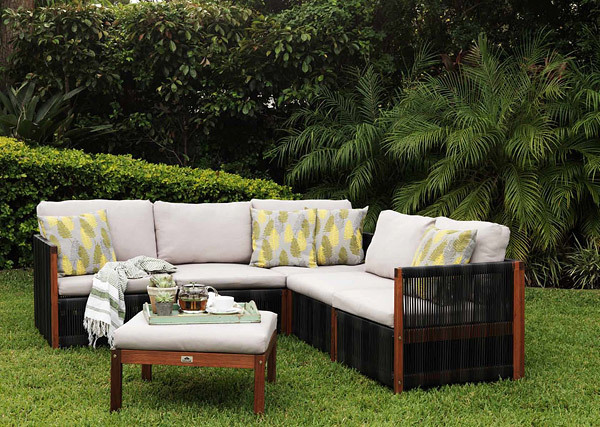
The Gymea modular range, part of the PATIO by Jamie Durie range.
The outdoor room is now accepted as a logical extension of indoor space – and I believe you have helped drive that understanding – what is your view on how we as Australians live outdoors?
One of the reasons I have developed the vertical garden blanket is to make the outdoor room more beautiful, as it utilises vertical space such as dead walls and ugly fences but leaves the lateral space for seating and dining outdoors. I went to Paris and met Patrick Blanc, the master of the vertical garden, and studied what he did, but from that understanding developed my own product.
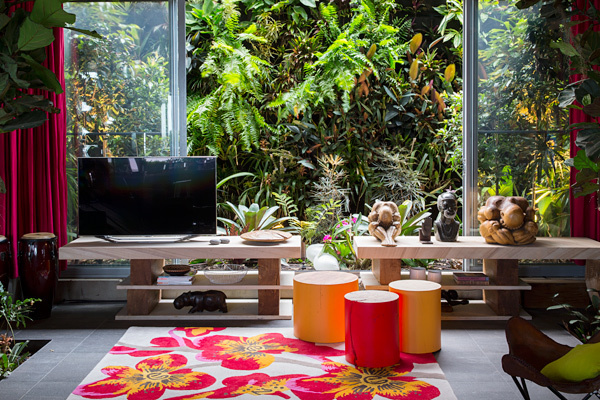
The vertical garden blanket at Jamie's Sydney home.
So how should the vertical garden blanket be used ideally, and do you use it yourself?
It comes as a pre-packaged geotextile fabric blanket (1.8m x.1.8m), made from recycled plastic bottles and an irrigation system. The pockets are offset to give a natural effect and filled with earth to wrap the root system of the plants. Good gardening is about abundance and about filling in bald spots so it is important to get the right mix of plants – grasses provide movement and texture, sweet potato plants add colour and depth, even certain weeds are great for filling as they grow aggressively. The watering system is simple - water drips down and when the top layers get a little dry in the sun, capillary action draws the water up again through the geotexile fabric. I have a huge vertical garden wall in my LA garden disguising my neighbour's wall and it really gives me pleasure every day.

Durie Design has been working on the installation of 62,000 new tropical plans and a formal feature garden and statement entrance at Hayman Island Resort.
Durie Design undertakes major resort and development projects globally as well as working with Hollywood A-listers. Do you have a design approach you apply to all projects?
I have the ability to look at a space and understand very quickly the gardening plan. I think in volumes and forms rather than specific plants – that comes later. For me it is all about reliable colour through combinations of foliage – flowers are the bonus.
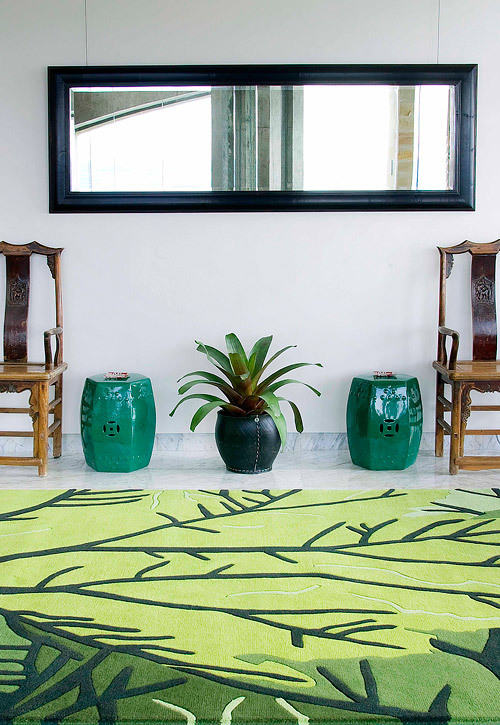
Jamie's 'Leaf Canopy' rug
Your collaboration with The Rug Collection is now in its 5th year for you. How did you tune into that design aesthetic that is more about texture and pattern making than form and function?
My approach to rugs was about taking outside in – for example one, in graduated orange is a sunset horizon another the ocean at one metre getting more intense towards the horizon, or the ocean in misty clouds. Our design concepts are overseen by Nadine Bush and our visuals are always beautifully styled to show how to link into a room visually through cushions and other decorative objects
Your People for Plants skincare range is a departure for a landscape designer, is it not? What spurred you in that direction?
Strangely I don't think it is a departure. I was a model for 10 years and know how to take care of my skin and the products are all about plants as the complete source of all the ingredients – so I sort of see it as different elements and phases of my life coming together.
The range was 4 years in the making. The idea came through friends of mine, Andrew and Anna. They brought me on board to find the best ingredients from plants. I travelled the world finding the best sources, for example where in Africa to find the best jojoba that has been grown to optimise its beneficial properties. It took me right back to plant knowledge. The range has taken off, as nothing in the range is over 30 dollars.
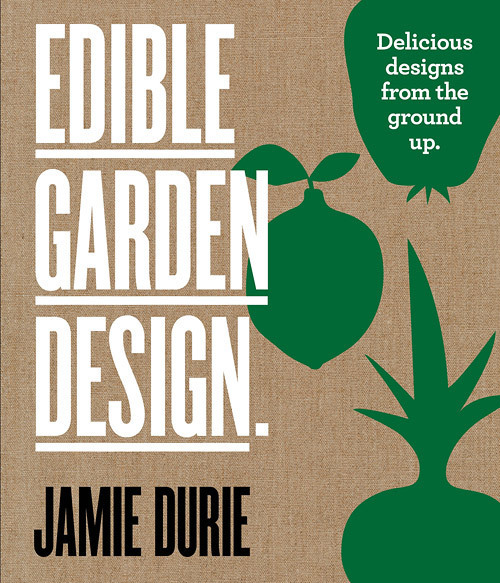
Edible Garden Design by Jamie Durie.
How do you have enough hours in the day to oversee everything? And do you see Sydney or LA as home?
I have a great team across the board – for example David Knott on the design side. I live roughly six months in Sydney and 6 in LA but Sydney is definitely home – there is a down-to-earth sensibility, a depth that I am appreciating more and more. It feels like a more conscious nation. I only hope we stand our ground on climate action on the global stage and don't go backwards!
Watch our video of Jamie explaining his Vertical Garden Blanket or shop for your own now.
Jamie Durie's World
Karen McCartney talks to Jamie Durie about his career, his passions and why every home needs a vertical garden.
Jamie Durie is a man of many, diverse talents. His name is synonymous, through his successful TV shows here and in the USA, with rethinking outdoor spaces. He has written ten best-selling books including his latest, Edible Garden Design, and collaborates with a number of partners producing outdoor and indoor furniture and rugs, not to mention an organic skincare range and his own vertical garden system. I did say diverse.
Jamie and I first met 13 years ago when Inside Out magazine was launching and he had a small but thriving garden design business, PATIO, in North Sydney. We ran a feature on one of his schemes in an early issue of the magazine and witnessed his phenomenal growth from young garden designer to mega-brand.
You have had an amazing career trajectory. When we first met you were promoting your garden design business and now you have an enormous diversity of projects and product designs …what happened?
I guess I have a lot of drive and energy. Growing up was not without its hardships and I think that drive pushed me to achieve. My choices are always things I am passionate about – money isn't the primary driver. My father always said to follow your passion and the pension will follow. That is not to say I haven't made mistakes – I am a creative person rather than a businessman. That said, I have been lucky with some of the collaborations that have come my way.
Furniture, both indoor and out, now forms a major part of your business with the most recent launch a collaboration with Italian company Riva 1920, which showed for the first time at the Milan Furniture Fair in April (2013) how did that come about?
It is an interesting story. Every morning at 5am Anna Riva (co-owner) does the family ironing and watched my TV show. She sent me an email and pack of catalogues of the Riva 1920 products. We were excited by what we saw and wrote back immediately to show her the furniture we were doing. She then asked me to come and stay at their farm, outside Milan, and work with them on a collection. It was a fantastic experience and they have become like family to me.
Jamie and David Knott from his design team at the Milan Furniture Fair with Jamie's Ficus Stool for Riva 1920. Image via Jamie's Pinterest board.
What was it like to launch a collection at the Milan Furniture Fair with all those serious design players?
Milan was so exciting – I was beside myself. We showed 9 pieces and are in the process of designing 16 more including chests of drawers and beds. Riva 1920 are able to source amazing materials; brass, pressed-leather, rose-tinted glass and even sea-weathered timbers dredged from Venetian canals.
The furniture has a feeling of timeless elegance – what aesthetic sensibility did you draw on to design them?
In 2006 I moved to LA and immersed myself in mid-century Modern design. I fell in love with the architecture of John Lautner and I bought a 1950's house in the Mulholland Hills and found original George Nelson lampshades in markets for $35 and even bought Bob Hope's original Eames Lounge chair in an auction. Although I did renovate the house, I still managed to spend more on the garden!
Tubular bookshelf and table and Bungalow stools, part of Jamie's designs for Riva 1920. Image via Jamie's Pinterest board.
The furniture pieces – such as the shelving unit - feel like they have a number of applications in people's homes. Is this part of the design philosophy?
Very much so. We like to empower people to make their own choices about how things should go together in their own homes so there is flexibility – pieces are modular or stackable. We apply the same thinking to our large-scale commercial pieces.
Do the design principles you apply to the Riva 1920 range also manifest in the Patio furniture range for Big W?
I have always pitched Big W to be democratic design – similar to the way Terence Conran pioneered it with Habitat in the UK. I want to make a wide range of good design accessible to the broadest range of people.
The Gymea modular range, part of the PATIO by Jamie Durie range.
The outdoor room is now accepted as a logical extension of indoor space – and I believe you have helped drive that understanding – what is your view on how we as Australians live outdoors?
One of the reasons I have developed the vertical garden blanket is to make the outdoor room more beautiful, as it utilises vertical space such as dead walls and ugly fences but leaves the lateral space for seating and dining outdoors. I went to Paris and met Patrick Blanc, the master of the vertical garden, and studied what he did, but from that understanding developed my own product.
The vertical garden blanket at Jamie's Sydney home.
So how should the vertical garden blanket be used ideally, and do you use it yourself?
It comes as a pre-packaged geotextile fabric blanket (1.8m x.1.8m), made from recycled plastic bottles and an irrigation system. The pockets are offset to give a natural effect and filled with earth to wrap the root system of the plants. Good gardening is about abundance and about filling in bald spots so it is important to get the right mix of plants – grasses provide movement and texture, sweet potato plants add colour and depth, even certain weeds are great for filling as they grow aggressively. The watering system is simple - water drips down and when the top layers get a little dry in the sun, capillary action draws the water up again through the geotexile fabric. I have a huge vertical garden wall in my LA garden disguising my neighbour's wall and it really gives me pleasure every day.
Durie Design has been working on the installation of 62,000 new tropical plans and a formal feature garden and statement entrance at Hayman Island Resort.
Durie Design undertakes major resort and development projects globally as well as working with Hollywood A-listers. Do you have a design approach you apply to all projects?
I have the ability to look at a space and understand very quickly the gardening plan. I think in volumes and forms rather than specific plants – that comes later. For me it is all about reliable colour through combinations of foliage – flowers are the bonus.
Jamie's 'Leaf Canopy' rug
Your collaboration with The Rug Collection is now in its 5th year for you. How did you tune into that design aesthetic that is more about texture and pattern making than form and function?
My approach to rugs was about taking outside in – for example one, in graduated orange is a sunset horizon another the ocean at one metre getting more intense towards the horizon, or the ocean in misty clouds. Our design concepts are overseen by Nadine Bush and our visuals are always beautifully styled to show how to link into a room visually through cushions and other decorative objects
Your People for Plants skincare range is a departure for a landscape designer, is it not? What spurred you in that direction?
Strangely I don't think it is a departure. I was a model for 10 years and know how to take care of my skin and the products are all about plants as the complete source of all the ingredients – so I sort of see it as different elements and phases of my life coming together.
The range was 4 years in the making. The idea came through friends of mine, Andrew and Anna. They brought me on board to find the best ingredients from plants. I travelled the world finding the best sources, for example where in Africa to find the best jojoba that has been grown to optimise its beneficial properties. It took me right back to plant knowledge. The range has taken off, as nothing in the range is over 30 dollars.
Edible Garden Design by Jamie Durie.
How do you have enough hours in the day to oversee everything? And do you see Sydney or LA as home?
I have a great team across the board – for example David Knott on the design side. I live roughly six months in Sydney and 6 in LA but Sydney is definitely home – there is a down-to-earth sensibility, a depth that I am appreciating more and more. It feels like a more conscious nation. I only hope we stand our ground on climate action on the global stage and don't go backwards!
Watch our video of Jamie explaining his Vertical Garden Blanket or shop for your own now.
Explore More



Payment options





Head Office (No Showroom)
2/1-7 Unwins Bridge Rd, St Peters,
NSW 2044, Australia
Your customer reference #:
01-X-CSN