



Updated 1 April 2021
Artisan Magazine introduces Alison Jackson
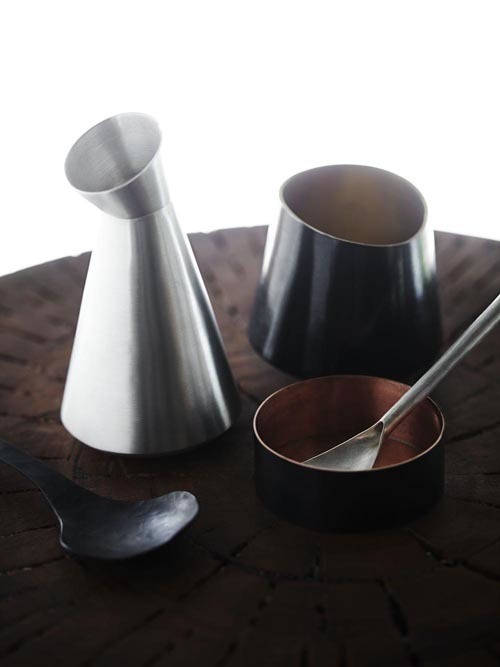
Artisan Magazine is the quarterly iPad publication of Natalie Hunfalvay, Leigh-Ann Thomas and Bhavani Konings. Following the blog post on Deb Taylor and Little White Dish, we bring you the next feature from Artisan Magazine: silversmith, Alison Jackson. Today we're sharing Alison's story and her creative process. Alison has generously offered an adorable set of her little spoons for one T&W member to win. Full details are below.
To receive the next issue, download Artisan Magazine directly from the App Store via your iPad (the link is here, or search for "Artisan Magazine"). You can also follow Artisan Magazine on Facebook, on Pinterest or on Instagram @artisanmagazine.
The Art of Silversmithing
The process of silversmithing, raising an object from a flat sheet into a hollow form, has always intrigued Alison. As a child she would always find herself working on small projects and fixing things like old kettles, billycarts, tables and containers. This fascination with working with metal and making things in her Father's workshop took on a life of its own. From age twelve, she took an after-school jewelry course, and she credits a wonderful teacher with inspiring her to make a career out of silversmithing.
Alison then pursued studies in Gold and Silversmithing at the Australian National University School of Art. Studying was a great chance to work with all the tools and machines she could ever need, and during her degree she learnt various techniques in silversmithing. Alison is drawn to silver because of its 'wonderful and unique malleability and luminosity'. She enjoys the freedom of working with silver: 'it amazes me what you can achieve with a sheet of metal and a hammer'.
Alison incorporates traditional silversmithing techniques in most of the work she produces. She combines these age-old techniques with a contemporary design aesthetic (using non-traditional materials, including other metals), producing pieces, which echo 'simplicity, functionality and a playful quirky twist'. Functionality is key to her work and she makes a range of tableware pieces such as spoons, bowls and containers – every piece made is 'designed to be used, to be held, explored and enjoyed'. Her design aesthetic draws upon themes of space and interaction. She is interested in the way people interact with objects, as well as how objects influence environments and become part of a living experience. She is particularly keen to design pieces that foster play. For example, 'many of pieces, when sitting on a static surface, tilter back and forth when touched, a playful quality that encourages user interaction.'
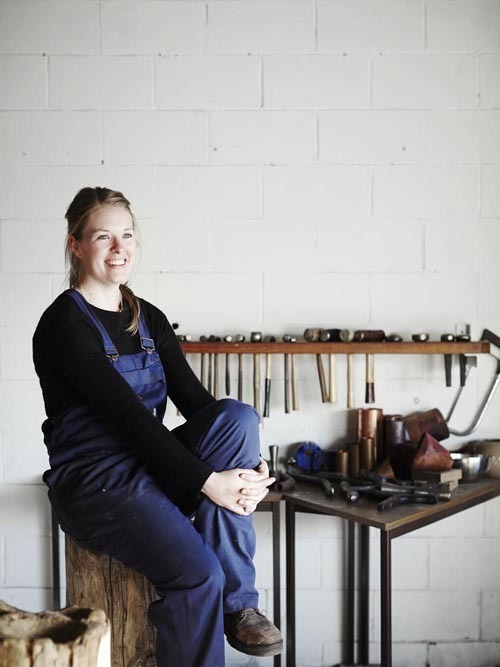
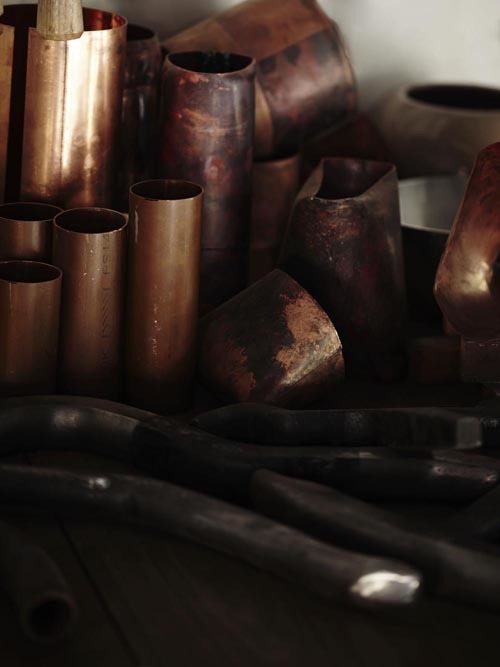
Alison's studio is a tool lover's dream. Starting Pocket Studio in 2008 with a friend from University, she was able to create a space to house her collection of tools and machines. As she exclaims, 'I have a soft spot for old tools, so I am forever collecting more beautiful tools for the studio!' The fully equipped jewelry and silversmithing studio allows her to run her own practice, teach short courses throughout the year and rent out space to other jewelers.
In Action
The silversmithing process of taking a flat sheet of metal and turning it into a beautiful piece of work involves many steps. Read along as Alison takes us through her handmade technique.
Marking Out
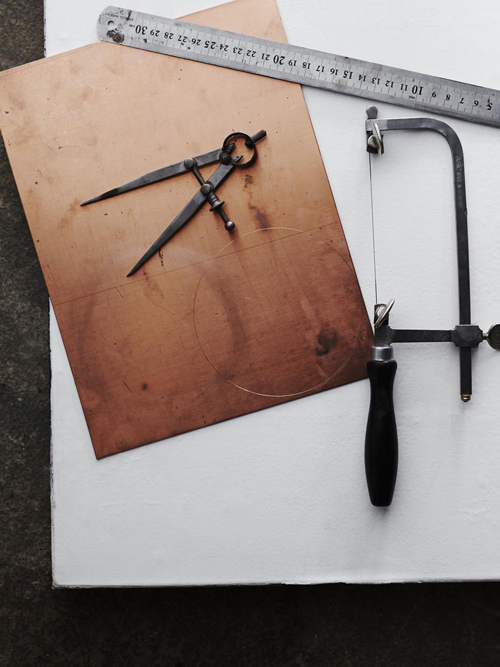
Starting with a flat sheet of metal (in this case, copper), a circle is marked on the surface using dividers. Then the circle is cut out by hand using a piecing saw.
Annealing
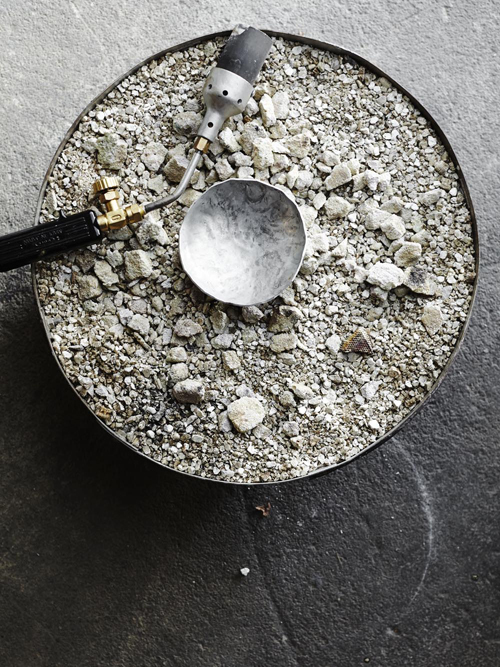
As the metal sheet is often bought in a hard or half hard state, it is necessary to anneal the sheet to make it ready to work. Annealing is a process whereby the sheet is heated above a particular temperature (each metal might have different points) and then cooled. This restores some of the ductility to the metal, allowing it to be more easily worked and formed. As soon as the metal is worked in any way (bending, forming, hammering etc), it begins to harden and therefore needs to be annealed again to restore softness and make it workable. Annealing is a process that takes place many, many times when hammering out the shape of the object. If you were to continue hammering the sheet it would eventually crack, and so to avoid this the sheet is annealed after each step.
Sinking
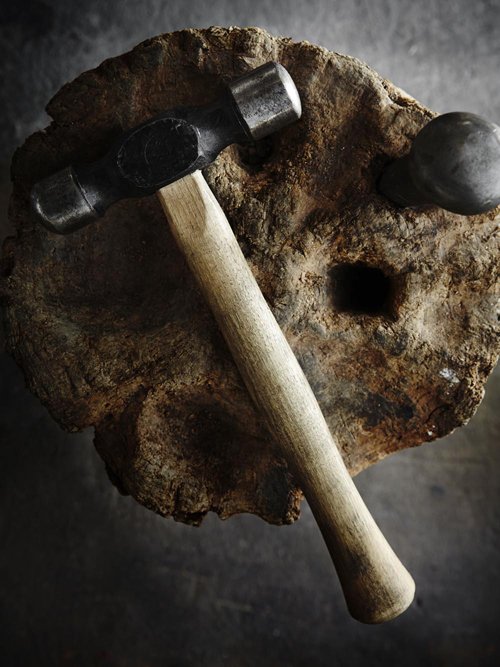
Sinking is the first stage of raising an object. Using a sinking hammer (a heavy hammer with one or both ends rounded and smooth), the sheet is hammered in a methodical circular pattern starting from the outside and working around towards the centre. The flat sheet of metal is hammered into a curved indentation, forming it into a small dish shape. Often a tree stump with various sized depressions carved into it is used. The tree stump provides a solid base to hammer into and absorbs much of the vibration from the hammer blows without marking the sheet that is being worked.
Raising (creating a curve)
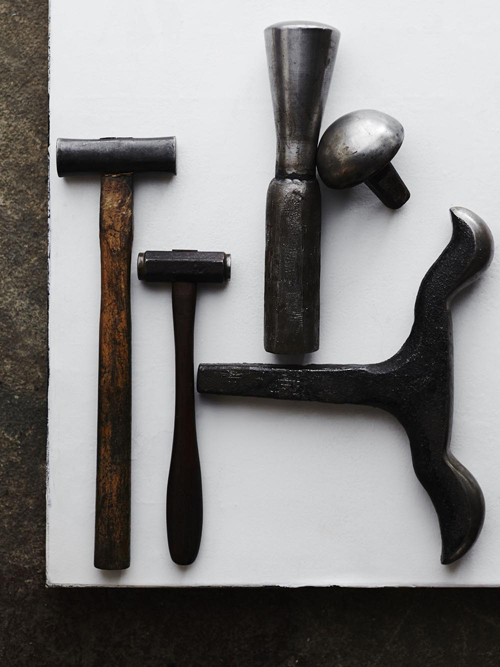
Raising occurs when the sheet is formed over a stake by repeated rounds of hammering. A raising hammer has a long rectangular shaped face. It is a very lengthy process, often taking days to complete one object. Stakes are specially shaped hammering surfaces used for various silversmithing tasks. Most commonly made from steel, they are very useful and versatile tools.
The metal sheet is held over the stake at an angle and, using a raising hammer, the sheet is worked in a circular motion starting from the inside working towards the outside edge. This is called one raise, and after each raise the sheet needs to be annealed again. This process is repeated as many times as is needed to form the sheet into the desired shape. Depending on the complexity of the object it may take from 10 to 50 raises (or more!). The angle of the sheet to the stake is very important in raising. If held incorrectly the sheet can be stretched thin and deformed. The idea with raising is that the sheet is formed without stretching any area too thin – if you start with 1mm sheet, the thickness of your finished object will still be 1mm.
Planishing
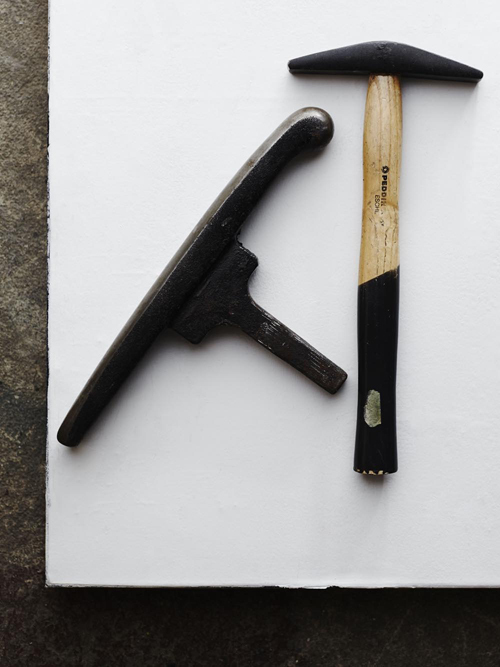
Planishing is a metalwork technique that finishes the surface by shaping and smoothing. A planishing hammer has a round face that is slightly domed and highly polished. The shape of the stakes used for planishing need to be the same as the piece, so they have odd shapes to reach into all areas of the object. The object is placed over the stake, and hammered slowly, with each hammer mark overlapping the next. Planishing refines the shape, removes the raising marks and creates a smooth surface. Usually an object will only be annealed once after the first planish. From this point the object will be continually hammered to harden it, creating a durable surface. Planishing is also quite a lengthy process, depending on the complexity of the shape it can take many hours to complete. Pieces can be left with a planished finish (a finely hammered surface), or can be further finished by filing the surface smooth, sanding and polishing.
5 Main Steps (and tools needed)
1. Marking Out – sheet metal, dividers, ruler and piercing saw
2. Annealing – torch and soldering pan
3. Sinking – Tree stump (good to use as it absorbs the hammer blows, vibrations) and sinking hammer
4. Raising – raising hammer and stakes
5. Planishing – planishing hammer and stakes
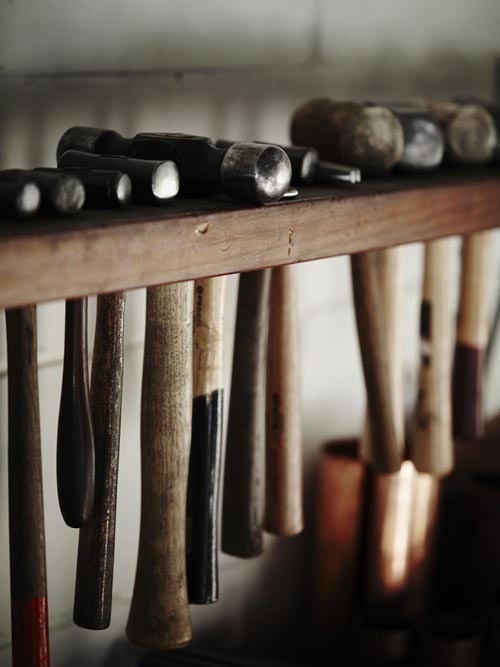
Alison's love for metal work is inspiring. She shares her knowledge and skills and runs classes – both jewelry classes and more specialized silversmithing workshops where she teaches students to make bowls and spoons. As she says, 'even if people only ever make one bowl, it is wonderful that they can see the huge amount of labour that goes into such a piece'. Indeed, in a time where traditional handmade techniques are replaced by machinery and mass production, we can appreciate and value the time it takes to create beauty.
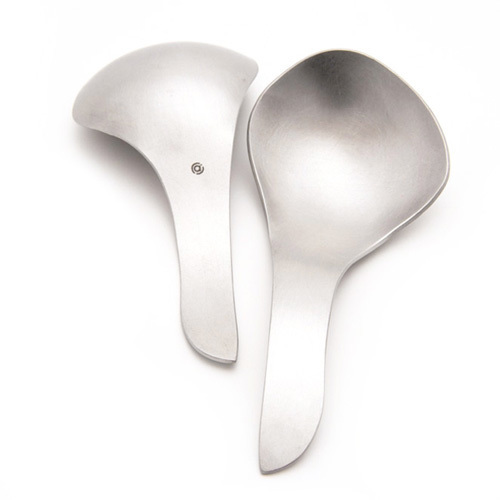
To win Alison's beautiful set of two stainless steel spoons, leave a comment here on the blog before 5pm (AEDT) on Friday 4 April 2014. You must be a member of Temple & Webster to enter, and you may only enter once. We will choose our favourite comment, and will notify the winner via their Facebook page or at the email address attached to their Temple & Webster account (if we are able to ascertain it) by Friday 11 April 2014. If we are unable to make contact with the winner via either of those methods within 30 days, we'll choose a replacement winner. Best of luck!
Competition closed.
Artisan Magazine is the quarterly iPad publication of Natalie Hunfalvay, Leigh-Ann Thomas and Bhavani Konings. Following the blog post on Deb Taylor and Little White Dish, we bring you the next feature from Artisan Magazine: silversmith, Alison Jackson. Today we're sharing Alison's story and her creative process. Alison has generously offered an adorable set of her little spoons for one T&W member to win. Full details are below.
To receive the next issue, download Artisan Magazine directly from the App Store via your iPad (the link is here, or search for "Artisan Magazine"). You can also follow Artisan Magazine on Facebook, on Pinterest or on Instagram @artisanmagazine.
The Art of Silversmithing
The process of silversmithing, raising an object from a flat sheet into a hollow form, has always intrigued Alison. As a child she would always find herself working on small projects and fixing things like old kettles, billycarts, tables and containers. This fascination with working with metal and making things in her Father's workshop took on a life of its own. From age twelve, she took an after-school jewelry course, and she credits a wonderful teacher with inspiring her to make a career out of silversmithing.
Alison then pursued studies in Gold and Silversmithing at the Australian National University School of Art. Studying was a great chance to work with all the tools and machines she could ever need, and during her degree she learnt various techniques in silversmithing. Alison is drawn to silver because of its 'wonderful and unique malleability and luminosity'. She enjoys the freedom of working with silver: 'it amazes me what you can achieve with a sheet of metal and a hammer'.
Alison incorporates traditional silversmithing techniques in most of the work she produces. She combines these age-old techniques with a contemporary design aesthetic (using non-traditional materials, including other metals), producing pieces, which echo 'simplicity, functionality and a playful quirky twist'. Functionality is key to her work and she makes a range of tableware pieces such as spoons, bowls and containers – every piece made is 'designed to be used, to be held, explored and enjoyed'. Her design aesthetic draws upon themes of space and interaction. She is interested in the way people interact with objects, as well as how objects influence environments and become part of a living experience. She is particularly keen to design pieces that foster play. For example, 'many of pieces, when sitting on a static surface, tilter back and forth when touched, a playful quality that encourages user interaction.'
Alison's studio is a tool lover's dream. Starting Pocket Studio in 2008 with a friend from University, she was able to create a space to house her collection of tools and machines. As she exclaims, 'I have a soft spot for old tools, so I am forever collecting more beautiful tools for the studio!' The fully equipped jewelry and silversmithing studio allows her to run her own practice, teach short courses throughout the year and rent out space to other jewelers.
In Action
The silversmithing process of taking a flat sheet of metal and turning it into a beautiful piece of work involves many steps. Read along as Alison takes us through her handmade technique.
Marking Out
Starting with a flat sheet of metal (in this case, copper), a circle is marked on the surface using dividers. Then the circle is cut out by hand using a piecing saw.
Annealing
As the metal sheet is often bought in a hard or half hard state, it is necessary to anneal the sheet to make it ready to work. Annealing is a process whereby the sheet is heated above a particular temperature (each metal might have different points) and then cooled. This restores some of the ductility to the metal, allowing it to be more easily worked and formed. As soon as the metal is worked in any way (bending, forming, hammering etc), it begins to harden and therefore needs to be annealed again to restore softness and make it workable. Annealing is a process that takes place many, many times when hammering out the shape of the object. If you were to continue hammering the sheet it would eventually crack, and so to avoid this the sheet is annealed after each step.
Sinking
Sinking is the first stage of raising an object. Using a sinking hammer (a heavy hammer with one or both ends rounded and smooth), the sheet is hammered in a methodical circular pattern starting from the outside and working around towards the centre. The flat sheet of metal is hammered into a curved indentation, forming it into a small dish shape. Often a tree stump with various sized depressions carved into it is used. The tree stump provides a solid base to hammer into and absorbs much of the vibration from the hammer blows without marking the sheet that is being worked.
Raising (creating a curve)
Raising occurs when the sheet is formed over a stake by repeated rounds of hammering. A raising hammer has a long rectangular shaped face. It is a very lengthy process, often taking days to complete one object. Stakes are specially shaped hammering surfaces used for various silversmithing tasks. Most commonly made from steel, they are very useful and versatile tools.
The metal sheet is held over the stake at an angle and, using a raising hammer, the sheet is worked in a circular motion starting from the inside working towards the outside edge. This is called one raise, and after each raise the sheet needs to be annealed again. This process is repeated as many times as is needed to form the sheet into the desired shape. Depending on the complexity of the object it may take from 10 to 50 raises (or more!). The angle of the sheet to the stake is very important in raising. If held incorrectly the sheet can be stretched thin and deformed. The idea with raising is that the sheet is formed without stretching any area too thin – if you start with 1mm sheet, the thickness of your finished object will still be 1mm.
Planishing
Planishing is a metalwork technique that finishes the surface by shaping and smoothing. A planishing hammer has a round face that is slightly domed and highly polished. The shape of the stakes used for planishing need to be the same as the piece, so they have odd shapes to reach into all areas of the object. The object is placed over the stake, and hammered slowly, with each hammer mark overlapping the next. Planishing refines the shape, removes the raising marks and creates a smooth surface. Usually an object will only be annealed once after the first planish. From this point the object will be continually hammered to harden it, creating a durable surface. Planishing is also quite a lengthy process, depending on the complexity of the shape it can take many hours to complete. Pieces can be left with a planished finish (a finely hammered surface), or can be further finished by filing the surface smooth, sanding and polishing.
5 Main Steps (and tools needed)
1. Marking Out – sheet metal, dividers, ruler and piercing saw
2. Annealing – torch and soldering pan
3. Sinking – Tree stump (good to use as it absorbs the hammer blows, vibrations) and sinking hammer
4. Raising – raising hammer and stakes
5. Planishing – planishing hammer and stakes
Alison's love for metal work is inspiring. She shares her knowledge and skills and runs classes – both jewelry classes and more specialized silversmithing workshops where she teaches students to make bowls and spoons. As she says, 'even if people only ever make one bowl, it is wonderful that they can see the huge amount of labour that goes into such a piece'. Indeed, in a time where traditional handmade techniques are replaced by machinery and mass production, we can appreciate and value the time it takes to create beauty.
To win Alison's beautiful set of two stainless steel spoons, leave a comment here on the blog before 5pm (AEDT) on Friday 4 April 2014. You must be a member of Temple & Webster to enter, and you may only enter once. We will choose our favourite comment, and will notify the winner via their Facebook page or at the email address attached to their Temple & Webster account (if we are able to ascertain it) by Friday 11 April 2014. If we are unable to make contact with the winner via either of those methods within 30 days, we'll choose a replacement winner. Best of luck!
Competition closed.
Explore More








Head Office (No Showroom)
2/1-7 Unwins Bridge Rd, St Peters,
NSW 2044, Australia
Your customer reference #:
01-X-CSN