

- Featured

- Featured
- Featured

Size
Material
Weave
Colour
Pattern
Features
Thread Count
Number in Set
Style
Special Offers
Customer Rating
Ships to
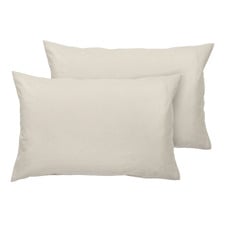
Fabric options available in our pillowcases
Waking up with a hot face every night regardless of how many blankets you’ve kicked off? Our pillowcases run from moisture-wicking linen and bamboo through to a crisp cotton percale weave with a thread count between 200 and 400. If you sleep warm, look at fibre before thread count: a 100% linen or bamboo pillowcase wicks moisture more effectively than a standard poly-cotton blend. Poly-cotton blends feel fine in a showroom, but they tend to trap heat against the skin overnight.
That’s exactly the problem a hot sleeper is trying to solve in the first place. If you’d rather prioritise a crisp, cool feel over breathability, a cotton weave in the 200 to 400 thread count range is the better pick. Plus, it tends to wash and wear well over years of regular use. If your current set’s seen better days, start here.
Shop our wider range of queen bed sheets to match your pillowcases exactly, or browse pink bedspreads if you’re after a bolder splash of colour across the whole bed.
European pillowcase sizing and pillow inserts
European pillowcases are designed for 65cm x 65cm square pillows, noticeably larger than a standard Australian bed pillow. They’re typically used as a decorative back row propped against the bedhead rather than as the pillow you actually sleep on each night. If you’re buying European pillowcases for the first time, check that you already have, or plan to purchase, European-sized pillow inserts to fill them properly.
A standard rectangular pillow crammed into a European case looks lumpy and undersized. It’s a mismatch that catches a lot of first-time buyers out, as the pillowcase and insert are sold separately and easy to assume are interchangeable. Buy the insert and case together, and you’ll avoid that disappointment entirely.
Round out the space with our bed sheets if you’re refreshing more than just the pillows.
Wash care for linen and bamboo pillowcases
Wash pillowcases every week in warm water on a gentle cycle. For people with acne-prone/sensitive skin, or allergies, every 2-4 days is recommended. Skin oils and dust mites can build up faster on pillowcases than on any other piece of bed linen simply because of how much direct facial contact they get every night. Tumble dry on low, or line dry in the shade, to preserve colour and finish. This matters particularly for linen and bamboo weaves: they can fade noticeably faster than cotton if left to dry in direct summer sun. Skipping that shade-drying step is one of the more common ways a good quality linen pillowcase ends up looking dull within a single season. If you rotate between two or more sets, you’ll spread out the washing frequency and extend the life of each individual pillowcase.
Mix with bedspreads for a lighter or heavier layer depending on the season.
Frequently asked questions
What is the difference between a standard pillowcase and a European pillowcase?
A standard Australian pillowcase fits a 48cm x 74cm rectangular pillow, while a European pillowcase is designed for a 65cm x 65cm square pillow. European pillowcases are typically sold individually or in pairs.
How many pillowcases come in a set?
This varies by product. Some listings are sold as a single pillowcase, some as a pair, and others as part of a complete sheet set.
What thread count is best for pillowcases?
A thread count of 200 to 400 in 100% cotton percale is considered the sweet spot for durability and comfort, while cotton sateen sits best between 300 to 600. Thread counts above 600 are often achieved by counting individual strands within multi-ply yarns, which doesn’t guarantee a softer feel. Instead, look for long-staple cotton like Egyptian or Pima, as these longer fibres produce a smoother, stronger fabric that lasts longer.
Are linen pillowcases good for sensitive skin?
Yes, linen is naturally hypoallergenic and becomes softer with each wash. It also has natural temperature-regulating properties, which can reduce night sweating.
How do I stop pillowcases from pilling?
Pilling is most common on lower thread count cotton blends and purely synthetic fibres like microfibre, and is accelerated by washing at high temperatures or a fast spin cycle. Washing in cool to warm water on a gentle cycle and air drying extends their life.
Explore More



We're here to help
We're available every day: 8am-8pm
Help Centre
To help us help you as quickly as possible, please include your customer reference #: 01-X-CSN
By using our website, you agree to our Terms and, by providing us with your information, you are agreeing to our Privacy Policy.